Tennessee Promise and HOPE: Your Complete Free College Guide
Tennessee spent $470,556,837 on free college in a single academic year — and thousands of qualifying students still left that money sitting on the table because they missed a deadline in October. That's the tension at the heart of the state's scholarship system: extraordinary generosity, punishing rigidity about process. Knowing how both programs work, and where the traps are, is the difference between graduating debt-free and paying full price.
What Tennessee Promise Actually Covers (and What It Doesn't)
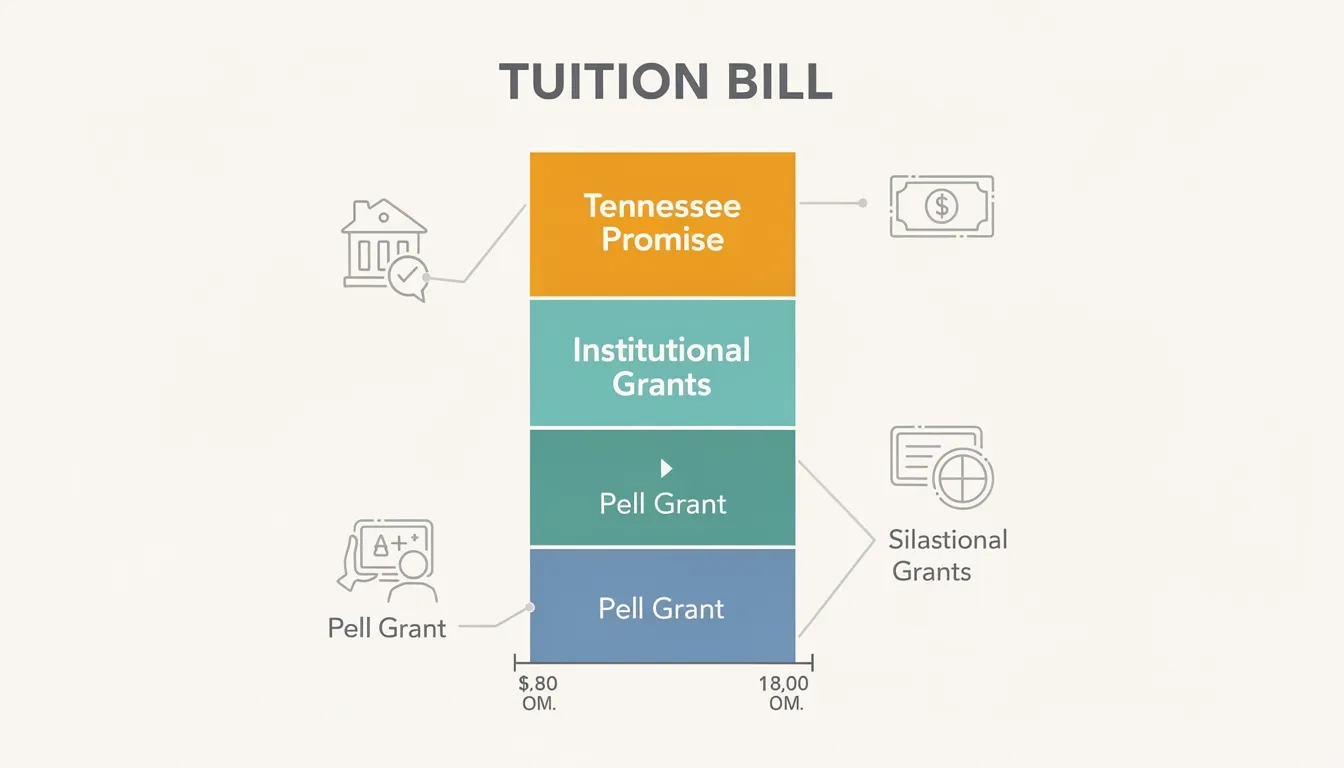
Tennessee Promise is a "last-dollar" scholarship, and that phrase is the most important thing to understand before anything else. It doesn't pay first — it pays last. After your Pell Grant, HOPE Scholarship, and any other state aid are applied, Promise covers whatever tuition gap remains.
At many community colleges, a student with full Pell eligibility and base HOPE already has their tuition nearly zeroed out. Promise finishes the job. But the scholarship strictly covers tuition and mandatory fees. Not textbooks. Not housing. Not program-specific supply fees.
The Tennessee Comptroller's 2024 evaluation found that even students with full Promise coverage still face at least $1,000 per year in out-of-pocket costs at community colleges, and up to $3,100 annually at a Tennessee College of Applied Technology (TCAT). Budget for that before assuming the total cost is zero.
Where Tennessee Promise applies:
- Two-year community colleges in the Tennessee system
- Tennessee Colleges of Applied Technology (TCATs)
- Coverage spans up to 5 semesters at a community college or 8 trimesters at a TCAT
Where it doesn't work:
- Four-year universities (separate programs exist for those — see UT Promise below)
- Part-time enrollment (Promise requires 12 or more credit hours each term, no exceptions)
- Students who have already graduated high school and missed the application window
One detail that catches students off guard: the five-semester clock starts from your first enrollment date, not your first semester of scholarship use. Take a semester without using Promise for any reason, and it still counts against the total.
The HOPE Scholarship: Tennessee's Lottery-Funded Merit Money
While Promise is about access, HOPE is about rewarding academic performance. Funded by the Tennessee Education Lottery (yes, scratch tickets are partially paying for this), HOPE works at both two-year and four-year institutions — which is the key distinction from Promise.
Initial eligibility is more accessible than most people expect. Students qualify with any one of these:
- A 21 or higher on the ACT
- A 1,060 or higher on the SAT (excluding the essay component)
- A 3.0 or higher unweighted high school GPA
That's a solid B average. Most students who graduate with reasonable academic effort qualify.
Award amounts vary based on where you enroll:
| Institution Type | Freshman / Sophomore | Junior / Senior |
|---|---|---|
| 4-year university | $2,250 per semester | $2,850 per semester |
| 2-year college | $1,600 per semester | $1,600 per semester |
The HOPE Tier System
Base HOPE is just the floor. Three layers sit above it:
- HOPE Aspire — A need-based supplement for families with an adjusted gross income of $36,000 or less. Stacks on top of base HOPE automatically if you file FAFSA and qualify.
- General Assembly Merit Scholarship (GAMS) — Pure merit, no income requirement. Requires both a 3.75 high school GPA and a 29 ACT. This is the scholarship that turns HOPE from a contribution into real coverage at a four-year institution.
- Non-Traditional HOPE — For adult learners and Tennessee Reconnect participants who didn't attend college right after high school. Requires continuous enrollment and a family AGI under $36,000.
GAMS is the elephant in the room that guidance counselors don't always flag early enough. A student who hits 3.75 and 29 ACT is in a completely different financial situation than one on base HOPE alone. Know which tier your student is aiming for before senior year starts.
How Promise and HOPE Stack Together
This is where Tennessee's design gets genuinely smart. The programs layer — they don't compete.
Consider a typical scenario: A Tennessee student with a 3.2 GPA and 22 ACT enrolls at a community college. They qualify for HOPE ($1,600 per semester) and Tennessee Promise. If they also receive the full Pell Grant (around $3,100 per semester for low-income students), the aid stack might look like this: Pell covers a large portion, HOPE fills more, and Promise zeros out whatever tuition remains.
Result: net tuition cost of $0.
The FAFSA is the key that unlocks the entire stack. Filing it is simultaneously applying for federal aid, HOPE, and Tennessee Promise. Students who skip the FAFSA — thinking it's only for low-income families — forfeit all three at once.
The FAFSA is not optional for Tennessee students. Every high schooler in the state should file it, regardless of family income, because both HOPE and Promise legally require it.
For students headed to four-year universities, HOPE plus GAMS (if eligible) becomes the primary funding tool. Add UT Promise for income-qualifying students, and you have meaningful coverage at a flagship campus.
The Community Service Trap
The number one reason Tennessee Promise applicants lose eligibility, per the Comptroller's 2024 evaluation, is not grades or GPA failure. It's community service.
The requirement seems simple: Complete 16 hours of community service before your first semester of college (during the summer after senior year). Then complete 8 hours per term for every semester you receive Promise funds. That's it.
But here's where students consistently stumble. The deadline is firm. There is no appeal process. Miss the August 1 pre-enrollment deadline and you permanently lose the scholarship. Not suspended. Not warned. Gone.
Practical rules for staying on the right side of this:
- Documented volunteer work at nonprofits, schools, government agencies, or similar organizations counts
- Paid work does not count, even if it's "service-adjacent"
- Your tnAchieves volunteer mentor tracks and verifies completion
- Start in June, not July — give yourself a buffer
The mentor relationship through tnAchieves exists specifically to prevent this kind of loss. Students who maintain regular contact with their mentor consistently retain eligibility at higher rates than those who go quiet after their initial pairing. A 20-minute phone call every few months is essentially protecting thousands of dollars in scholarship money.
UT Promise: Free Tuition at UT System Campuses
For families below a specific income threshold, Tennessee has quietly built a pathway to free tuition at University of Tennessee campuses — Knoxville, Chattanooga, Southern, Martin, and the Health Science Center.
UT Promise requires two conditions, both must be met:
- Family household income under $75,000 (based on adjusted gross income)
- Total household assets under $75,000
If you clear both thresholds and qualify for the HOPE Scholarship, UT Promise covers remaining tuition and mandatory fees after all other aid is applied. It functions the same way Tennessee Promise does, but at four-year UT System institutions instead of community colleges.
A family earning $72,000 per year whose student has a 3.0 GPA could potentially attend UT Knoxville — one of the larger research universities in the Southeast — at essentially no tuition cost. The income limit is real, but it's broader than many middle-income families assume. Check before writing off UT System schools as unaffordable.
UT Promise is a separate program from Tennessee Promise. You can't use both simultaneously at the same school — they target different student populations and different institution types.
Deadlines and the Mistakes That End Eligibility
Tennessee's scholarship programs run on fixed deadlines with almost no flexibility built in. For the incoming Class of 2026, the timeline looks like this:
| Milestone | Deadline |
|---|---|
| TN Promise application opens | August 2025 |
| TN Promise application deadline | November 3, 2025 |
| Mandatory tnAchieves spring meeting | March 16, 2026 |
| FAFSA deadline for TN programs | April 1, 2026 |
| Pre-enrollment community service (16 hrs) | August 1, 2026 |
| Full-time fall enrollment begins | August/September 2026 |
The November deadline is the one families miss most often. It falls during fall of senior year, before most students are thinking about college paperwork. By the time December arrives and the deadline has passed, there is no reinstatement path.
The spring mandatory meeting is the second most common failure point. It looks optional on a calendar. It isn't. Skipping it ends eligibility just as permanently as missing November.
A few other non-obvious rules worth knowing: If your high school GPA is right on the 3.0 borderline for HOPE, ask your guidance counselor whether advanced placement or honors course weighting can push your calculated GPA over the threshold. Tennessee uses a specific calculation that assigns bonus points to rigorous coursework — a student sitting at a 2.97 unweighted might clear 3.0 on the adjusted scale.
And HOPE has its own deadline rhythm: file FAFSA by September 1 for fall enrollment, March 1 for spring. Miss either, and you're paying out of pocket that semester even if you're academically eligible.
Bottom Line
Tennessee's scholarship system awards nearly half a billion dollars a year, and most of it is genuinely accessible to middle-class and lower-income families — not just students with perfect test scores. But the programs reward preparation, not just academic performance. A student with a 3.1 GPA who files in October and finishes community service in July beats a 3.5 student who misses November every single time.
Here is what to actually do:
- File the FAFSA in October of senior year, not April. Both HOPE and Promise require it, and filing early opens the full stack.
- Apply for Tennessee Promise by November 3. This deadline has no grace period and no second chance.
- Complete 16 hours of community service by July — before the August 1 cutoff — and stay in contact with your tnAchieves mentor.
- Know your HOPE tier. If ACT is 29+ and GPA is 3.75+, pursue GAMS — it's a meaningfully different award than base HOPE.
- Income-eligible families should check UT Promise. The $75,000 combined income and asset threshold makes UT System campuses a realistic option for more families than expect.
The free college is real. The clock starts in October of 11th grade, when students should begin tracking GPA and ACT benchmarks before senior year deadlines arrive.
Frequently Asked Questions
Can Tennessee Promise be used at a 4-year university?
Not directly. Tennessee Promise is limited to community colleges and TCATs. Students sometimes use it to complete an associate degree, then transfer to a four-year school. For direct four-year coverage, UT Promise is the equivalent program — but it carries income requirements that Tennessee Promise does not.
What happens if you lose Tennessee Promise eligibility — can you get it back?
No. Tennessee Promise has no reinstatement process for any reason. Missing the November application deadline, skipping the mandatory spring meeting, failing to complete community service, or dropping below full-time enrollment all result in permanent disqualification. There is no appeal mechanism.
Does Tennessee Promise cover textbooks or housing?
No. Promise covers tuition and mandatory fees only. The Comptroller's 2024 evaluation confirmed that community college students still face a minimum of around $1,000 per year in uncovered costs, primarily books and transportation. TCAT students can face up to $3,100 annually in additional out-of-pocket expenses.
Is the HOPE Scholarship only for students attending public colleges?
No. HOPE covers eligible students at both public and private Tennessee institutions. Schools like Belmont University and Union University participate in the HOPE program. That said, HOPE's flat award amount typically covers a smaller share of tuition at private institutions, where sticker prices run significantly higher than at public schools.
What's the real difference between HOPE Aspire and GAMS?
HOPE Aspire is need-based — it's a supplement for families with AGI of $36,000 or less, automatically added on top of base HOPE if you qualify. GAMS is merit-based with no income requirement — it requires a 3.75 GPA and a 29 ACT simultaneously. If a student qualifies for both, they receive whichever pays more. They cannot be combined and stacked on top of each other.
If a student's GPA falls and they lose HOPE, can they get it back?
Once. Tennessee allows students to regain HOPE eligibility one time if they fall below the required GPA benchmark and then recover it. After that single reinstatement, a second GPA drop results in permanent loss of the scholarship. This is why the GPA maintenance timeline — 2.75 after 24 to 48 credit hours, rising to 3.0 after 72 — matters to track actively, not just at the end of the year.
Sources
- TN Promise | tnAchieves
- Tennessee HOPE Scholarship | CollegeForTN.org
- Tennessee Promise Students Have More Successful Higher Education Outcomes | TN Comptroller
- Types of TN HOPE Scholarships and Supplemental Awards | UTC Financial Aid
- UT Promise Scholarship | University of Tennessee System
- Tennessee Scholarships & Grants 2026 | ScholarshipsandGrants.us