Top Scholarships for Psychology Majors in 2026
Most psychology students start their scholarship search on Google, scroll through a few listicles, and apply to three or four general awards they've never heard of before. Then they wonder why nothing comes through.
Here's what those listicles don't tell you: the American Psychological Foundation distributes over $2 million every year across more than 95 programs. The National Science Foundation's Graduate Research Fellowship pays $34,000 annually for three years. Niche awards for sub-specialties like neuropsychology, school psychology, and forensic psychology regularly go undersubscribed because applicants don't know they exist.
The money is there. The strategy is knowing where to look and what to say.
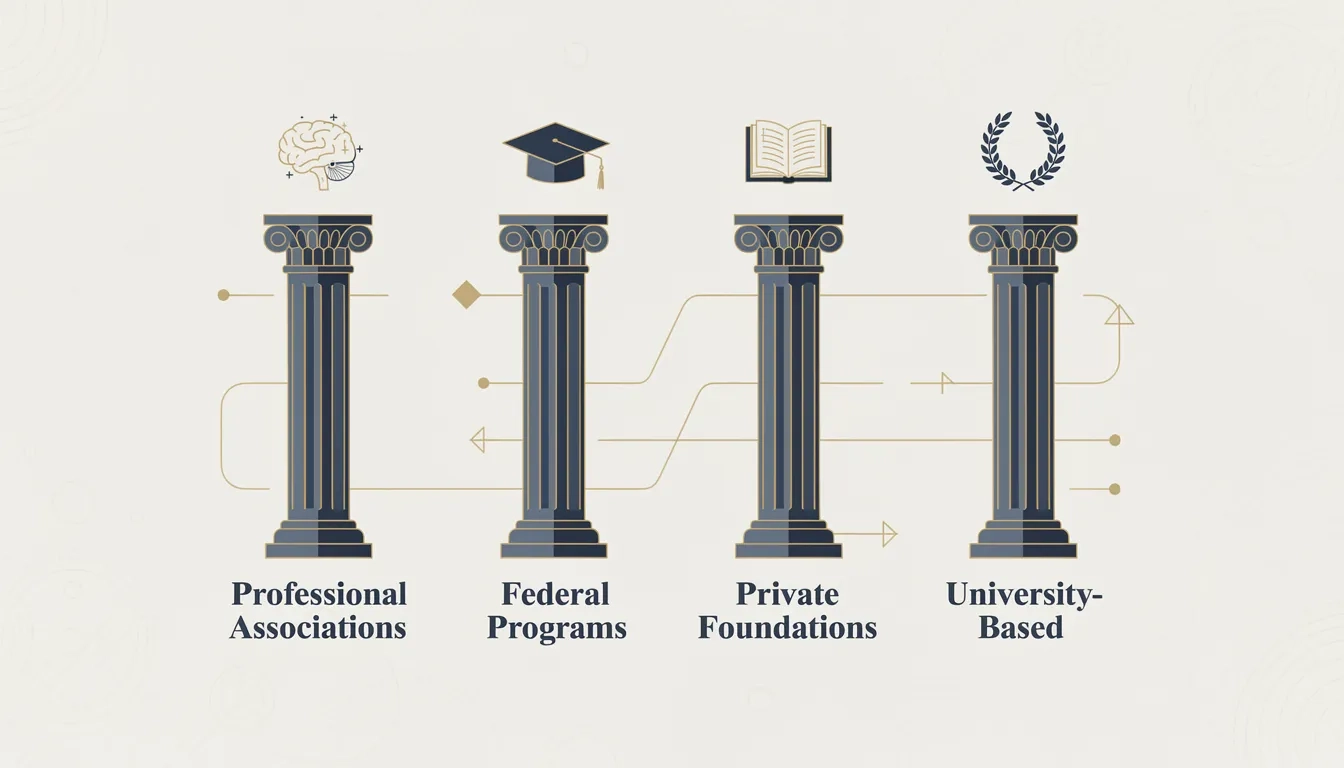
The Four Pillars of Psychology Funding
Before listing specific awards, it helps to understand which organizations actually control the money. Almost everything traces back to four sources.
The American Psychological Foundation (APF) is the single largest private funder of psychology students. Their portfolio runs from $1,000 research micro-grants to the Mentored Research Scholar Grant, which can reach $135,000 for cancer psychology work. Their deadlines span the calendar year (March 1, July 1, and November 1 for Visionary Grants), so you can apply in multiple cycles.
Psi Chi, the International Honor Society in Psychology, functions as a scholarship multiplier. Membership unlocks access to their own awards AND is a required or preferred qualifier for dozens of third-party scholarships. If you're not a member yet, that's probably the highest-ROI move you can make this semester.
The American Psychological Association (APA) and its Graduate Students affiliate (APAGS) run a separate set of awards, many tied to specific divisions like forensic psychology, I-O psychology, and school psychology. Division membership (often $15-$30/year) opens application doors.
The National Science Foundation operates at a different scale entirely. The NSF GRFP isn't psychology-specific, but behavioral and social science proposals have a strong acceptance track record — and a $34,000 annual stipend with a $16,000 education allowance is hard to match anywhere else.
Top Undergraduate Scholarships
These are the awards worth prioritizing if you're in your first four years.
| Scholarship | Award | Eligibility | Deadline |
|---|---|---|---|
| Sharon Stephens Brehm Scholarship (APF) | $5,000 | Psychology major, 3.5+ GPA, financial need | July |
| Psi Chi Undergraduate Scholarship | $3,000 | Psi Chi member, psychology undergrad | June |
| Inez Beverly Prosser Scholarship | $3,000 | Psi Chi member, woman of color | June |
| NIH Undergraduate Scholarship | Up to $20,000 | 3.3+ GPA, financial need, behavioral/biomedical sciences | March |
| Ethel Hayes Destigmatization Scholarship | $7,630 | Students personally affected by mental health challenges | June 13 |
| Henry Respert Alzheimer's Awareness Scholarship | $7,500 | Undergrads in neuroscience, psychology, medical research | August |
| Dr. Shuqiao Yao Memorial Scholarship | $2,000 | Asian heritage, psychology or psychiatry major, 3.0+ GPA | December |
The Sharon Stephens Brehm Scholarship is the prestige undergraduate award in the field — named after a past president of APA, it carries real weight on a CV and requires a 3.5+ GPA with demonstrated financial need. Apply through the APF's GivingData portal.
The NIH Undergraduate Scholarship is the sleeper pick on this list. It's competitive (they want 3.3+ GPA and financial need), but it pays up to $20,000 and includes summer research opportunities at NIH labs in Bethesda. Most students skip it because they assume it's "for pre-med." Psychology and behavioral science proposals are explicitly eligible.
A common mistake here: applying only to the biggest award on the list. A $1,000 AP-LS grant or a $500 Condon Prize for Best Student Essay carry far less competition, take similar time to write, and an award is an award when it comes to grad school applications.
Top Graduate Fellowships and Grants
Graduate funding gets more complex, and the amounts get significantly larger.
The NSF Graduate Research Fellowship Program remains the gold standard. Three years of support, including a $34,000 annual stipend, is simply the best deal in academic psychology. The application requires a research proposal and personal statement, with proposals reviewed by panels of scientists — not administrators. Cognitive, developmental, social, and clinical psychology all have strong representation in past award cohorts.
"The GRFP is funded by the federal government specifically to keep talented researchers in U.S. science. That mission works in psychology's favor — behavioral research is increasingly seen as central to health, education, and social policy."
The COGDOP Graduate Student Scholarships from the American Psychological Foundation deserve more attention than they get. There are nine named awards totaling up to $5,000 each, with a June 26, 2026 deadline. The review committee emphasizes the clarity of your research question and context — not GPA. Applications require a research proposal (10 pages max), a CV, and department endorsement.
The named awards within COGDOP include:
- $5,000 Harry and Miriam Levinson Scholarship
- $5,000 Charles and Carol Spielberger Scholarship
- $5,000 Peter and Malina James Legacy Scholarship
- $3,000 William and Dorothy Bevan Scholarship
- $2,500 William C. Howell Scholarship
The Elizabeth Munsterberg Koppitz Child Psychology Graduate Fellowship pays $25,000 for graduate students focused on child psychology — a sub-specialty with genuine workforce shortages and strong funding interest.
For clinical students, the NBCC Minority Fellowship Program offers $20,000 in support for doctoral candidates pursuing mental health counseling careers, with a specific mandate to serve underrepresented communities.
Specialty and Niche Awards
This is where the real opportunity lives. General scholarships attract thousands of applicants. Niche awards? Dozens, sometimes fewer.
For I-O Psychology students: The Lee Hakel Graduate Student Scholarship from SIOP pays $3,500 annually. The Mary L. Tenopyr Award is a separate $3,000 award through the same nomination cycle. Both require SIOP student membership.
For school psychology students: The NASP-ERT Minority Scholarship pays $5,000 and is specifically targeted at graduate students from underrepresented backgrounds. The Bilingual School Psychologist Scholarship awards up to $9,000 for postgraduate students — one of the higher per-student amounts in the entire field.
For forensic/legal psychology students: The AP-LS (American Psychology-Law Society) runs a robust funding ecosystem: Grants-in-Aid for undergraduates (up to $1,000), Student Grants-in-Aid for graduate students (up to $2,000), and the Research to Enhance Impact and Diversification grant, which can reach $50,000 for early career researchers.
For students with a focus on LGBTQ+ research: The APF Wayne F. Placek Grants award $10,000 for behavioral science research on lesbian and gay issues. Competition is genuinely lower here because the pool of applicants who both do this research and know about the award is small.
For neuropsychology students: The Benton-Meier Scholarships pay $2,500 for students in neuropsychology programs and are administered through the APF.
One non-obvious pick: the Stokes Scholarship Program, sponsored by the CIA's Directorate of Analysis, pays up to $25,000 and includes paid internships. It's open to behavioral and social science students with strong academic records. The June 30, 2026 deadline is firm.
How to Build a Winning Application
The mechanics of a psychology scholarship application look similar across most awards: essays, transcripts, letters of recommendation, and sometimes a research proposal. Where most applicants go wrong is treating these as a checklist rather than a coherent narrative.
Match your specialty to the award. A forensic psychology student applying for a general APF grant competes against everyone. The same student applying for an AP-LS award competes against a much smaller, more relevant pool. The specificity of the award is a feature, not a constraint.
Get your recommenders involved early. This sounds obvious, but many recommenders write stronger letters when they know the specific award criteria. Send them the program description alongside your request, not just your CV.
For research-based awards like the COGDOP scholarships or the NSF GRFP, the proposal is everything. The COGDOP review committee explicitly says they evaluate "the clarity and comprehensibility of the research question" above all else. Write the research question before you write anything else, and get a non-specialist to read it. If they can't explain what you're trying to find out, rewrite it.
A realistic application timeline for spring awards looks like this:
- October–November: Identify target awards, request transcripts and committee letters
- December–January: Draft essays and research proposals; revise based on feedback
- February–March: Submit to awards with spring deadlines (NIH, Beth N. Rom-Rymer, APS Albert Bandura)
- May–June: Submit to summer-cycle awards (COGDOP, Psi Chi, AP-LS)
- July–August: Submit to late-cycle awards (Brehm, Henry Respert)
Red Flags and Missed Opportunities
The most common mistake isn't applying to the wrong scholarships. It's not joining Psi Chi.
Membership is invitation-based (you need to rank in the top 35% of your class or meet the GPA threshold set by your chapter, typically 3.0+), but the payoff is disproportionate. Psi Chi membership qualifies you for a distinct set of awards that non-members can't access, and it signals research orientation to graduate admissions committees at the same time.
The second biggest miss is ignoring APA division memberships. APA has 54 divisions — everything from Division 8 (Personality and Social Psychology) to Division 41 (Psychology and Law). Each division runs its own awards. Annual student membership in a division costs between $15 and $30. That's an entry fee to a much smaller scholarship pool.
One more thing worth saying directly: applying to scholarships in the $500–$2,500 range is not beneath you. Award recipients are listed publicly. They show up in grad school applications. They build a record of recognition that compounds over time, and the smaller pools mean your odds are genuinely different. Don't skip the Condon Prize or the APS student grant because the dollar amount feels small.
Bottom Line
- Join Psi Chi if you haven't already — it's a scholarship multiplier, not just a credential
- Match niche awards to your subspecialty: I-O, forensic, school, neuropsychology, and LGBTQ+ research all have dedicated funding with smaller applicant pools
- Graduate students should prioritize the NSF GRFP above almost everything else — $34,000/year for three years is genuinely transformative
- Work the two application cycles: spring deadlines cluster in February–March, summer deadlines cluster in June–July; you can run both each year
- Apply to smaller awards ($500–$2,500) alongside the big ones — every listed award strengthens your professional record
The students who actually find this funding aren't the highest-GPA students. They're the ones who spend 3 hours mapping the scholarship landscape before they write a single word of an essay.
Frequently Asked Questions
Do I need to be a member of a professional organization to apply for psychology scholarships?
Not for all of them, but membership helps. Psi Chi membership is required for their scholarship suite and preferred for many APF awards. APA division memberships (typically $15–$30/year for students) open access to division-specific grants. For awards like the NSF GRFP or NIH Undergraduate Scholarship, no professional membership is required.
What GPA do I need to qualify for most psychology scholarships?
The most common threshold is 3.0 (required for awards like the COGDOP scholarships and many APF programs), but it varies. The Sharon Stephens Brehm Scholarship requires 3.5+, the NIH Undergraduate Scholarship asks for 3.3+, and some scholarships like the Arnetha V. Bishop Memorial Scholarship accept applicants with a 2.5+ GPA. A handful of research-focused awards weight the proposal quality more than GPA.
Is the NSF GRFP really worth applying to as a psychology student?
Yes — and this is a myth worth busting directly. Many behavioral science students assume the GRFP skews toward STEM and don't apply. In practice, social, behavioral, and economic sciences are a distinct funding track within the GRFP, and psychology proposals have a real track record of success. The $34,000 stipend plus $16,000 education allowance for three years represents approximately $150,000 in total support, which dwarfs most other awards in the field.
How early should I start applying for scholarships?
Earlier than you think. Spring-cycle applications (for awards with February–March deadlines) require letters of recommendation, transcripts, and sometimes research proposals — materials that take 6–8 weeks to gather properly. Students who begin building their application materials in October or November of the previous year consistently report less stress and better essay quality. Starting in January for a February deadline is functionally too late to write a strong research proposal.
Are there scholarships specifically for psychology students from minority or underrepresented backgrounds?
Several, and they're worth knowing specifically. The Inez Beverly Prosser Scholarship ($3,000) serves women of color through Psi Chi. The NASP-ERT Minority Scholarship ($5,000) targets school psychology students from underrepresented backgrounds. The NBCC Minority Fellowship Program ($20,000) supports doctoral-level mental health counseling students. The Arnetha V. Bishop Memorial Scholarship ($500) is open to BIPOC students in mental health-related fields. The CVS Aetna HBCU Scholarship awards up to $10,000 for students at Historically Black Colleges and Universities pursuing psychology or related health fields.
Can undergraduate students apply for research grants, or are those only for graduate students?
Both. The AP-LS Grants-in-Aid for Undergraduates pays up to $1,000 for research projects. The Association for Psychological Science offers $500 student research grants. The AED Student Research Grants through APF award $1,000 for eating disorders research. These are smaller than graduate research awards, but they fund real projects and give you published or presented research to cite in graduate school applications — which is often worth more than the dollar amount.