ROTC Programs: How to Win a Full Scholarship Military Path
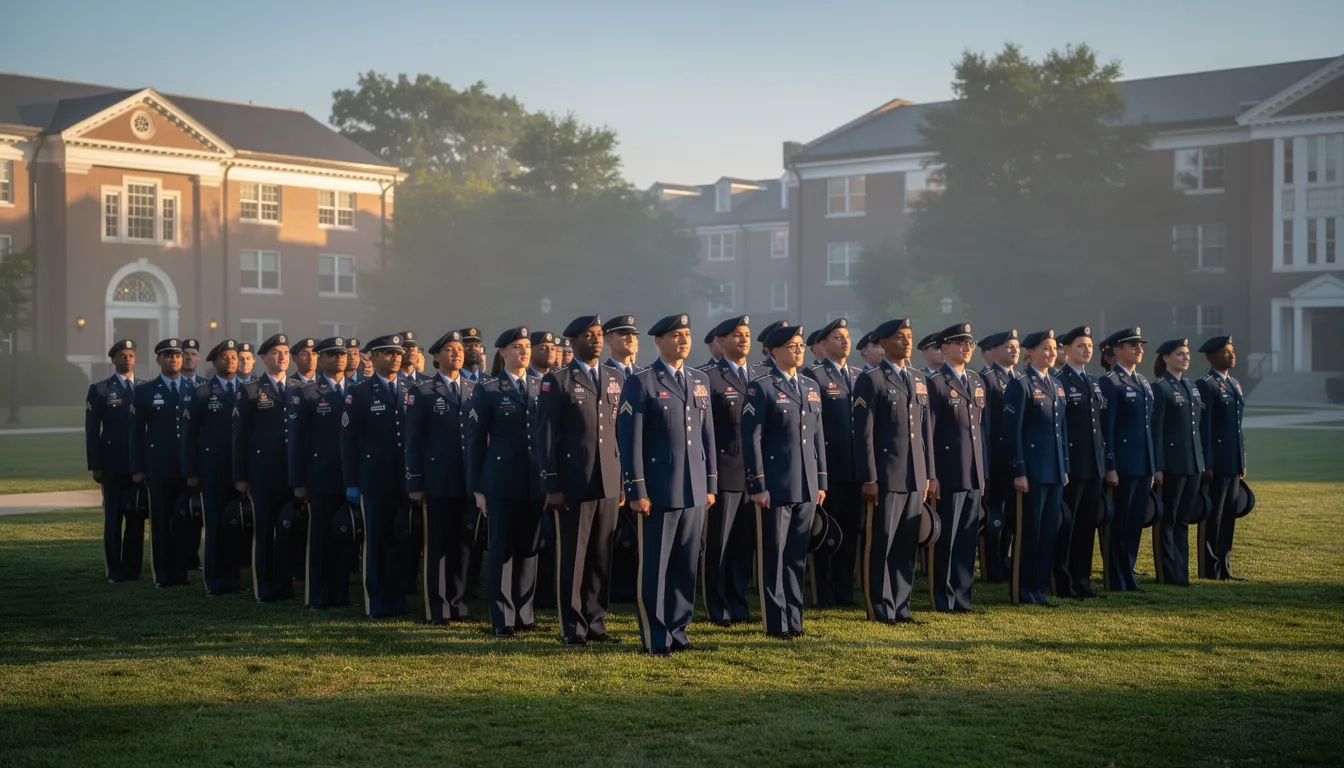
The NROTC four-year national scholarship is worth up to $152,000 at a private university — more than most merit packages from highly selective schools, with a post-graduation career path attached. Yet Navy ROTC accepts only about 13% of applicants. Most students who could qualify never apply, either because they don't understand how the program works or because they hear "military commitment" and stop reading.
That's a mistake worth correcting.
What ROTC Actually Is (and Isn't)
ROTC stands for Reserve Officers' Training Corps. The basic deal: attend any participating college, take military science courses alongside your normal degree, complete summer training, and graduate with both a bachelor's degree and a commission as an officer in the Army, Navy, Marines, or Air Force.
It's not a military academy. You live in regular dorms, take regular classes with civilian students, and manage your own schedule. The military structure shows up in your ROTC coursework, weekly labs, and physical training sessions — typically eight to twelve hours per week depending on the program and year.
The scholarship piece is entirely separate from ROTC enrollment. You can join ROTC without scholarship funding, and many students do. But scholarship recipients have their education largely paid for in exchange for a defined service commitment after graduation. That exchange is the core of the whole arrangement.
The Three Programs, Side by Side
| Branch | Program Name | Approx. Scholarships Awarded (2024–25) | Acceptance Rate |
|---|---|---|---|
| Army | Army ROTC / Cadet Command | ~3,000 | Most accessible |
| Navy / Marine Corps | NROTC | ~1,900 | ~13% |
| Air Force | AFROTC | ~500 | ~20% |
Army ROTC operates at over 1,000 colleges and universities — by far the widest reach of the three. Navy and Air Force programs run at fewer schools, and their scholarship pools are tighter.
NROTC contains two separate tracks within one program. You apply for either the Navy Option (commissioning as an Ensign in surface warfare, submarines, aviation, special warfare, or nursing) or the Marine Corps Option. The Marine track carries higher physical fitness expectations and heavier tactical field training. Same scholarship eligibility, very different day-to-day experience.
One lesser-known option inside NROTC: the Tweedale Scholarship, which specifically targets students majoring in engineering, mathematics, computer science, chemistry, or physics. If your intended major fits that list, it's worth knowing that specialized slot exists.
What the Scholarship Actually Pays For
This is where people are often surprised. A full ROTC scholarship doesn't waive a portion of tuition — it covers the whole academic bill.
Army ROTC scholarships pay full tuition and fees at any of the 1,000+ participating schools, plus a $1,200 annual book stipend, plus a monthly living allowance of $420 for each of the 10 academic months per year. That's $4,200 in spending money on top of covered tuition.
NROTC scholarships cover full tuition, mandatory fees, a $750 annual textbook allowance, and monthly allowances that scale by class year: $250 per month as a freshman, scaling to $400 per month as a senior. At a private university, the four-year total clears $152,000 in value. Students also complete three summer training cruises — aboard nuclear submarines, with carrier aviation squadrons, or on surface warships — gaining hands-on experience that no classroom produces.
Air Force ROTC in-college scholarships pay up to $18,000 per year in tuition (capped at $9,000 per semester or $6,000 per quarter), plus a book allowance, a monthly subsistence stipend, uniforms, and travel costs for required training events.
One detail people miss: these scholarships can be used at essentially any participating school, not a curated list of military-friendly institutions. Want to study engineering at a large research university or nursing at a private school? If that school hosts an ROTC program (and most do), your scholarship applies there.
How Selection Actually Works
The Army frames its ideal candidate around what it calls the SAL criteria: Scholar, Athlete, Leader. That shorthand explains a lot about how boards evaluate files.
Academics matter, but not the way GPA-obsessed applicants expect. Minimum GPA is 2.5 for Army, 3.0 for Air Force. Competitive applicants typically run a 3.5 or higher. Raw grades matter less than rigor — boards want evidence you challenged yourself. SAT scores count too; hitting above 1,250 on the SAT (or 25 on the ACT), combined with a solid officer interview, clears the bar for at least a 3-year Army scholarship, according to ROTC Consulting, a firm specializing in ROTC application coaching.
Physical fitness is non-negotiable. Army applicants take the Army Combat Fitness Test (ACFT). Boards want candidates who are already fit, not planning to get fit. A weak score can kill an otherwise strong file.
Leadership gets weighted more than most applicants realize. Holding a title — team captain, club president, student council officer — counts, but boards distinguish between nominal positions and real responsibility. Explain the decisions you made and the outcomes that followed, not just the role you held.
The application process, step by step:
- Create an account on the branch-specific scholarship portal
- Submit transcripts, test scores, and a personal statement
- Complete the branch-required physical fitness assessment
- Complete an in-person interview with a commissioned officer
- Submit a medical screening through DoDMETS (the Defense Department's medical evaluation system)
- Wait for board review — Army boards run in October, January, and March cycles
Get the fitness test and interview done early. The October board for Army scholarships typically has the largest number of available slots.
The Service Commitment: The Part People Underestimate
Taking an ROTC scholarship means committing to military service. There's no graceful exit once you've accepted and drawn down the money.
If you disenroll after your sophomore year (or after crossing certain funding thresholds), you're typically required either to repay all scholarship funds received or to fulfill the obligation through active-duty enlisted service. This is spelled out in the scholarship contract. Read it before you sign.
Here's what the obligation actually looks like by branch:
| Branch | Active Duty | Reserve Obligation |
|---|---|---|
| Army | 4 years active | Up to 4 years Army Reserve or National Guard (8 years total) |
| Navy | 5 years active | None additional |
| Marine Corps | 4 years active | None additional |
| Air Force (non-flight) | 4 years active | None additional |
| Air Force (pilot) | 10 years active | None additional |
The Air Force pilot track stands out. Ten years is a long commitment. But that pipeline includes Undergraduate Pilot Training worth several million dollars in government investment per pilot. People who complete their service and transition to commercial aviation walk into interviews with a 1,500-hour flight log that civilian flight school graduates spend years and $80,000 building.
The Army's 8-year total is not 8 years of active duty. Four years active, four years in the Reserve or National Guard. Many officers do their active component, then serve in the Reserve while working a civilian career in parallel. That's a legitimate path, not a fallback.
Building an Application That Actually Wins
Most students who lose the scholarship competition weren't unqualified. They were just unprepared — and that's a fixable problem.
Start building your Scholar-Athlete-Leader profile no later than spring of 11th grade. Getting elected team captain in March, completing a summer leadership program in July, and submitting your scholarship application by October is a realistic and competitive timeline. Trying to manufacture that same record in the three months before the October board? The seams show.
A few moves that separate winning files from losing ones:
- Apply to schools with ROTC programs directly on campus, not ones that cross-enroll at a nearby institution. Being 200 yards from the cadre officers who write your recommendation letters matters.
- Contact the Recruiting Operations Officer at your target school before submitting your application. They can flag gaps in your file, clarify what the local cadre values, and in some cases advocate for your application with the board.
- Practice the officer interview out loud, not in your head. It's conducted by a commissioned officer and evaluated on bearing, confidence, and knowledge of military structure and service. Five mock interviews will beat five hours of reading about it every time.
Apply in the first available board cycle. Scholarship slots are distributed across the year's review boards, and the first board typically carries the largest pool.
Is ROTC Worth It?
My honest take: yes, for the right person — and clearly no for others.
If you're drawn to military service, ROTC beats most other paths for a specific reason: you graduate with a bachelor's degree, an officer's commission, and zero educational debt. The service academies give you the same commission but require four years inside a completely military environment. ROTC lets you have a normal college experience alongside the military training, on a campus of your choosing.
The people who struggle most with ROTC scholarships took them primarily for the money. Four years as a commissioned officer is a real commitment that takes you to duty stations you didn't choose, puts you in charge of people under high-stakes conditions, and shapes the first decade of your career in hard-to-undo ways. Going in with eyes open is not optional. It's the whole thing.
For people who genuinely want to serve and lead? ROTC is one of the best financial deals in American higher education. The writing is on the wall when you run the numbers: full tuition plus stipends plus post-graduation salary, versus four years of tuition debt plus a slower entry into the workforce. The math is lopsided.
Bottom Line
- Army ROTC is the most accessible starting point — most scholarships, most participating schools, lowest minimum GPA threshold. Start there if you're undecided on branch.
- Build your Scholar-Athlete-Leader profile starting in 11th grade, not the summer before you apply. Leadership narratives take time to develop.
- Contact the ROTC cadre at your target school early. That relationship influences your application in ways the online portal doesn't capture.
- Understand the service contract before you sign. These aren't loans — they're binding commitments with repayment clauses for non-compliance.
- Apply in the first board cycle. For Army ROTC, the October board has the most slots. Don't default to the March deadline unless you have no choice.
Frequently Asked Questions
Can you join ROTC without receiving a scholarship?
Yes. Most ROTC programs allow students to enroll as non-scholarship cadets (sometimes called "walk-ons") who take the same coursework and training without receiving financial aid. Non-scholarship cadets can still compete for in-college scholarships after enrollment and can still earn a commission upon program completion. It's a practical way to try the program before committing financially.
Does an ROTC scholarship reduce other financial aid?
It depends entirely on the school. Some institutions treat ROTC scholarships as outside aid and reduce their own institutional grants dollar-for-dollar. Others allow the funds to stack with merit or need-based aid. Before you commit, ask the financial aid office directly how they handle ROTC awards — the answer can shift your net cost by thousands of dollars per year, and schools vary widely.
Is the Army ROTC scholarship genuinely easier to win than NROTC or AFROTC?
Based on the numbers, yes. Army ROTC awards roughly 3,000 scholarships per year versus about 500 for Air Force and 1,900 for Navy/Marine Corps. Army programs also operate at more schools and accept a lower minimum GPA. That said, "easier" is relative — you still need a competitive academic record, demonstrated leadership, and a strong fitness score. The Army scholarship has a lower floor, not a low bar.
What happens if I accept the scholarship and later decide not to serve?
If you disenroll from the program after your sophomore year or after receiving scholarship funds past a defined threshold, you're typically required to either repay all scholarship funds received or fulfill the obligation as an active-duty enlisted service member. The specific terms depend on how much funding you drew and which branch you enrolled in. This is laid out in the scholarship contract — read it carefully before signing.
Which ROTC branch is best for someone who wants to fly military aircraft?
Air Force ROTC is the most direct path to fixed-wing military aviation. Pilot candidates face a 10-year active-duty obligation after commissioning, but the entire training pipeline, including Undergraduate Pilot Training, is covered by the Air Force. Army ROTC leads primarily to rotary-wing aviation (helicopters), with a shorter service obligation. Navy ROTC can lead to naval aviation for both carrier aircraft and helicopters. The right branch depends on what you want to fly.
When should high school students start the ROTC scholarship application?
Army ROTC scholarship applications open in June of the year before you enroll in college. The first review board meets in late October, so documents need to be submitted by early October. Realistically, building the competitive application — fitness scores, leadership record, officer interview prep — should start 12 to 18 months before that October board, meaning the spring of 11th grade at the latest.
Sources
- Army Scholarships - ROTC Cadet Command
- ROTC Scholarships | U.S. Army
- Scholarships | U.S. Air Force ROTC
- Naval Reserve Officer Training (NROTC) | Navy.com
- Paying For College: Navy ROTC Scholarships | Military.com
- ROTC Scholarship - How to Qualify and Find | CollegeData
- 2025-2026 Army ROTC Scholarship Deadlines | ROTC Consulting