How to Succeed as an Environmental Science Major in College
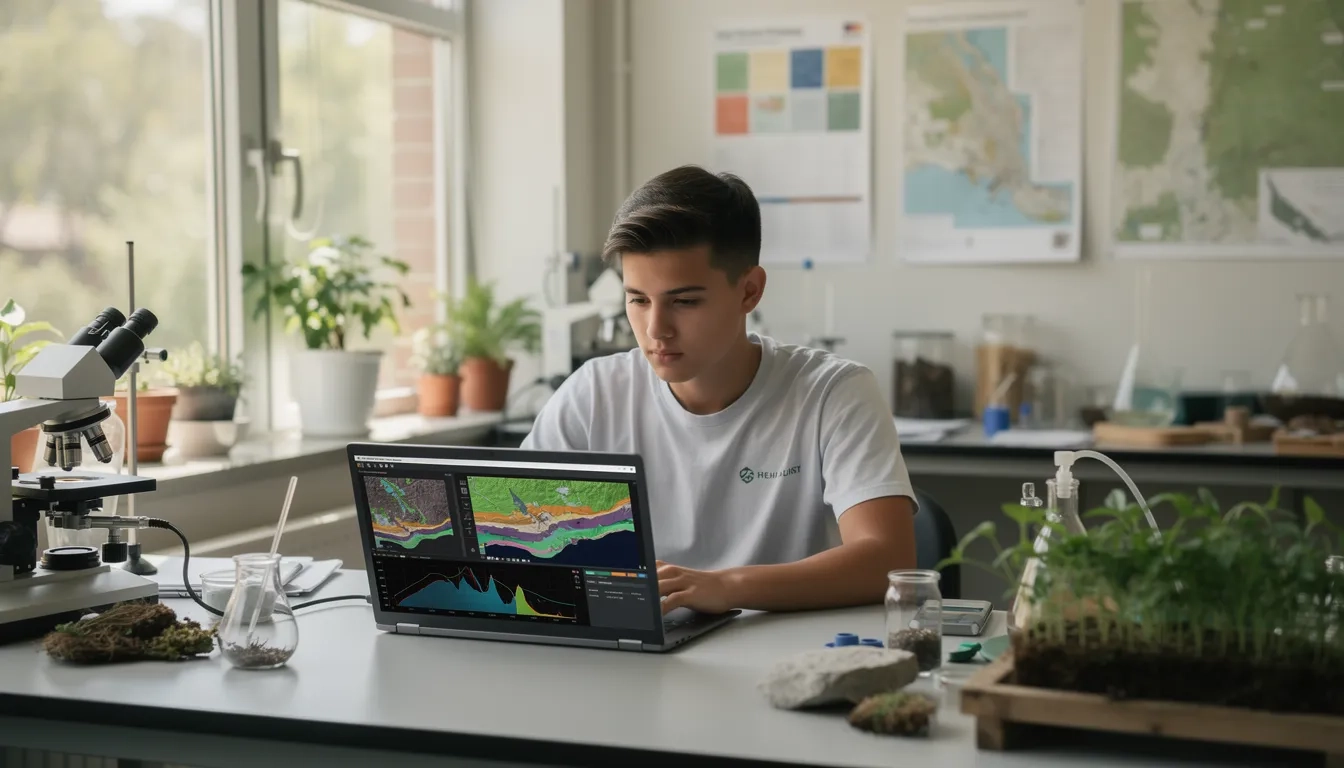
Every fall, a fresh crop of environmental science majors shows up to orientation picturing themselves knee-deep in a wetland with a clipboard, or maybe hugging a very old tree for a photo op. By sophomore year, a lot of them are instead hunched over a laptop running a statistical model on soil contaminant data, wondering when the "environmental" part of their degree is going to show up again.
Here's the honest version: it already showed up. You're just not doing it the way you imagined.
Environmental science is one of the most interdisciplinary majors on campus — you'll touch chemistry, biology, geology, statistics, and policy, sometimes in the same week. That breadth is exactly why it can feel disorienting. This guide walks through what the coursework actually demands, which experiences genuinely move your resume forward, and how to navigate a job market that's shifting fast — especially with federal environmental hiring in a rough patch right now.
The Common Misconception: It's Not Mostly Hiking
Let's deal with this one up front, because it derails more students than any single class ever will.
The assumption goes like this: environmental science = outdoor science = fieldwork = the fun stuff. And sure, fieldwork exists. But if you map out a typical four-year plan, the credit hours tell a different story. You'll spend far more time in a lab quantifying nitrate levels in a water sample, or in front of a computer running regression analysis on decades of temperature data, than you will collecting the sample itself.
The field component is real, but it's the smallest slice of the pie. The bulk of the major — and the bulk of the actual job afterward — is lab science, data analysis, and increasingly, geospatial software. Employers aren't primarily hiring people who are comfortable outside. They're hiring people who can take messy environmental data and turn it into a defensible conclusion, a compliance report, or a policy recommendation.
If you came into this major to escape math and chemistry, that's the misconception to correct as early as freshman year — ideally before you're staring down organic chemistry and biostatistics in the same semester and wondering what happened.
The students who struggle most aren't the ones who can't identify a tree species — they're the ones who never got comfortable with statistics. In this field, a spreadsheet will teach you more about the environment than a hiking boot ever will.
What the Coursework Actually Looks Like
A typical environmental science curriculum blends four pillars:
- Natural sciences core — general chemistry, biology, and often geology or earth science, laying the foundation for everything else.
- Quantitative methods — statistics is close to non-negotiable now, and many programs are adding introductory Python or R specifically for environmental data work.
- Geospatial tools — GIS (Geographic Information Systems) coursework has gone from "nice elective" to expected baseline in most programs, because so much environmental analysis is inherently spatial (watersheds, land use, pollution plumes, habitat ranges).
- Policy and social science — environmental regulation, economics, and often an ethics or environmental justice course, since so much of the actual job involves navigating rules, not just running instruments.
According to the U.S. Bureau of Labor Statistics, coursework in chemistry, geology, and physics forms the backbone of the credential employers expect, with hydrology, waste management, and environmental policy called out as valuable specializations depending on which direction you're headed.
A few practical study habits that pay off disproportionately:
- Take the statistics requirement seriously — don't just clear the bar. It's the single most transferable skill in the major.
- Get into a GIS course as early as your schedule allows, even if it's not required until junior year. It compounds — the earlier you're fluent, the more research opportunities open up.
- Don't treat policy classes as filler. Regulatory literacy is what separates a technician from someone who gets promoted into project management.
- If your program offers any programming exposure (Python, R), take it. Environmental datasets are large and messy, and manual spreadsheet work doesn't scale.
Internships and Field Experience That Actually Matter
Employers and REU program directors both say the same thing: internships and field experience aren't optional extras for this major, they're closer to a prerequisite for a first job. But not all internships are created equal, and application timelines are unforgiving — competitive programs often fill 3-6 months before the position starts.
Here's a realistic map of where to look:
Federal and research-agency programs (often paid, often the most competitive):
- National Park Service seasonal science and field positions — applications typically open in December and close in January for summer roles.
- NSF's Research Experience for Undergraduates (REU) sites, which place students directly into active research projects.
- The Smithsonian Environmental Research Center runs paid summer and remote internships in environmental research and public engagement, with a minimum stipend around $700/week — a program worth applying to specifically because it's structured, mentored, and resume-recognizable.
- DOE fellowships administered through Oak Ridge Institute for Science and Education.
Nonprofits:
- Environmental Defense Fund, Sierra Club, World Wildlife Fund, and the Student Conservation Association all take undergraduates, though pay varies widely — larger nonprofits tend to pay, smaller conservation groups often don't (sometimes offsetting with housing).
Private sector:
- Environmental consulting firms and renewable energy companies increasingly offer paid internships (roughly 3-12 months), and this route often pays better than the nonprofit path while still building relevant, resume-worthy experience.
A tactical note: geographic flexibility matters more than it used to, since remote research-support and data-analysis internships have become a real supplement to the traditional "live in a field station for a summer" model. If your family or finances make relocating for a summer difficult, that's no longer a dead end.
Certifications Worth Getting Before You Graduate
Most students don't realize you can start building professional credentials before you even have the degree in hand. The one worth knowing about is GISP (Certified GIS Professional), administered by the GIS Certification Institute (GISCI). Full GISP requires a mix of education points, documented professional experience, and an exam — which usually puts it a few years past graduation for most people.
But GISCI also runs a PreGISP (GISP-E) pathway aimed specifically at students and early-career people. It signals to employers that you're serious about the geospatial side of the field well before you've accumulated the work-experience points required for full certification — genuinely useful if you're trying to differentiate yourself from other new grads with an otherwise similar transcript.
Environmental Scientist vs. Environmental Science Technician: Know the Difference
A lot of students conflate these two roles, which leads to confusion about what "success" even looks like right out of college. They're related but distinct career tracks, and knowing the difference helps you plan your coursework and job search realistically.
| Environmental Scientist | Environmental Science & Protection Technician | |
|---|---|---|
| Typical entry education | Bachelor's degree | Associate's degree (varies, up to bachelor's) |
| Median annual pay (2025) | $82,220 | $55,090 |
| Core work | Research design, data analysis, report writing, oversight | Field sampling, lab testing, inspections, monitoring |
| Supervision | Often directs technicians | Works under scientists' direction |
| Projected growth (2025-2035) | 6% | 7% |
| Best fit for | Students completing the full 4-year degree | Students wanting field/lab work sooner, or a stepping stone role |
Both paths are legitimate, and plenty of people start as a technician and move into a scientist role once they finish a degree or build enough field experience. The point is not to assume "environmental science major" locks you into one lane.
The Federal Hiring Problem You Need to Plan Around
This is the part most college advising pages won't tell you plainly, so let's say it directly: federal environmental hiring has taken a serious hit, and it changes how you should plan your job search.
Through 2025, the EPA has cut its workforce by roughly a quarter — from about 16,155 employees down toward a projected 9,700 by year's end, a staffing level not seen since the 1970s. The agency eliminated its entire Office of Research and Development, affecting well over a thousand scientists, chemists, and toxicologists. If your mental model of "environmental science job" was "I'll go work for the EPA," that door is currently much narrower than it was even three years ago.
This doesn't mean the field is shrinking overall — BLS still projects 6-7% growth for environmental scientists and technicians through the mid-2030s, with thousands of annual openings. But the growth is increasingly happening outside the federal government:
- State and local agencies still employ the largest single share of environmental scientists and haven't seen cuts at the federal scale.
- Private consulting and engineering firms are absorbing a growing share of environmental work, including a lot of the compliance and remediation work federal agencies used to do more of directly.
- Corporate sustainability roles are genuinely expanding — carbon accounting, ESG reporting, and supply-chain sustainability positions have become common at large companies, blending environmental science with business and data skills.
- Renewable energy — solar, wind, and energy-efficiency consulting — is a steadily growing employer category for people with this background.
The practical takeaway: don't build your entire career plan around a federal agency job right now. Build toward the skill set (GIS, data analysis, regulatory literacy) that's portable across state government, consulting, and the private sector, and you'll be insulated from a single sector's hiring freeze.
Bottom Line
Environmental science rewards students who treat it as the quantitative, lab-heavy science it actually is — not the outdoor-adventure major it's sometimes marketed as. The people who do well are the ones who take statistics and GIS seriously, get into a real internship (paid, structured, ideally federal or research-agency backed) before senior year, and stay flexible about which sector — government, consulting, or corporate sustainability — ends up hiring them.
- Get comfortable with statistics and at least one data/GIS tool early — it's the most transferable skill in the entire degree.
- Apply to internships 3-6 months ahead of the deadline you think you have — competitive programs fill fast.
- Consider the PreGISP pathway if you're gravitating toward the geospatial side of the field.
- Don't over-anchor on federal agency jobs — EPA hiring has contracted sharply; state agencies, consulting firms, and corporate sustainability teams are the more reliable near-term paths.
- Take policy and regulation courses seriously — they're what separates entry-level technicians from people who get promoted into project leadership.
Frequently Asked Questions
Is environmental science a hard major? It's demanding in a specific way — the chemistry, statistics, and lab components are rigorous, and the breadth across natural science, data analysis, and policy means you rarely get to coast in just one skill area. It's less about raw difficulty and more about needing to stay competent across several very different types of coursework at once.
Do I need to be good at math for environmental science? You need to be comfortable with statistics specifically, more than advanced math generally. Regression analysis, data interpretation, and increasingly some programming (Python or R) show up constantly in coursework and in the actual job.
What's the difference between environmental science and environmental studies? Environmental science is generally the more quantitative, lab-and-field-based track (chemistry, biology, data analysis), while environmental studies tends to lean more heavily into policy, social science, and the humanities side of environmental issues. Check your specific program — the naming isn't fully standardized across schools.
Can I get a good job with just a bachelor's degree in environmental science? Yes — a bachelor's is the standard entry-level requirement for the environmental scientist role, with a median pay around $82,220. Some specialized or research-heavy roles benefit from a master's, but it's not required to start.
Are environmental science jobs actually growing right now? Overall yes — BLS projects 6% growth for environmental scientists and 7% for environmental science technicians through the mid-2030s. But the growth isn't evenly distributed: federal agency hiring (especially EPA) has contracted significantly in 2025, while state agencies, private consulting, and corporate sustainability roles are picking up more of the demand.
Is GIS really necessary, or can I skip it? It's close to essential at this point. Most environmental analysis — watershed modeling, land use, pollution mapping, habitat assessment — is spatial by nature, and GIS fluency shows up as a baseline expectation in job postings, not a bonus skill.
Sources
- Environmental Scientists and Specialists — Occupational Outlook Handbook, U.S. BLS
- Environmental Science and Protection Technicians — Occupational Outlook Handbook, U.S. BLS
- Trump administration is on track to cut 1 in 3 EPA staffers by the end of 2025 — Government Executive
- GIS Certification Institute (GISCI) — GISP Certification
- Environmental Science Internships: Complete 2026 Guide
- Environmental Science Careers: Jobs, Salaries & Pathways
- Internships — Smithsonian Environmental Research Center