The Best Free College Research Tools Online (2026)
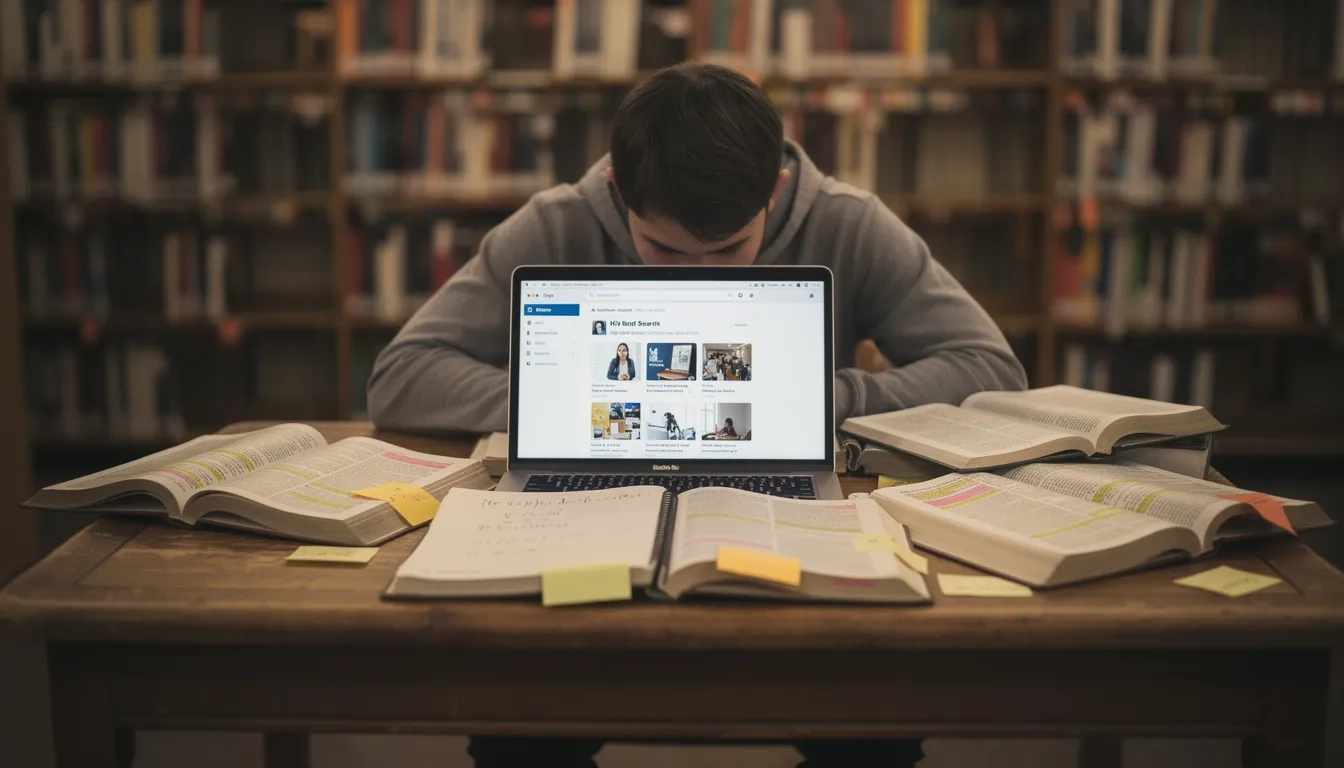
You're three hours into a research paper when you find the exact article you need. Published in a top journal, cited 847 times, directly relevant to your thesis. You click the link.
Forty-eight-hour access: $35.95.
That's the state of academic publishing for millions of college students. Here's what most people don't realize, though: a genuinely powerful research library is sitting out there for free, right now, without logging into a single paywall. You just have to know where to look — and which tools are worth your time.
The Search Engines Doing the Heavy Lifting
Most students open Google, search their topic, and skim the first three results. That's a fine way to find news articles and Reddit threads. It's a terrible way to write an academic paper.
Google Scholar is sitting right there, completely free, indexing roughly 200 million scholarly articles across every discipline. It ranks results by citation count and publication quality, not by ad spend. For most undergraduate and graduate papers, it's the right place to start.
But Scholar has a real limitation: it shows you the abstract and citation, not always the full text. That's where Semantic Scholar earns its reputation. Built by the Allen Institute for AI and entirely free (no account required), it indexes 220 million papers and adds something Scholar doesn't: AI-generated TLDR summaries for each paper. You can evaluate whether an article is actually relevant in about 11 seconds. Researchers at Stanford, MIT, and Oxford use it as a standard part of their workflow, and it's worth treating it as your default search engine rather than a backup.
CORE covers 136 million articles and its entire index is open-access, meaning every result links to a free full PDF. No click-through surprises. BASE (Bielefeld Academic Search Engine) indexes another 136 million articles from institutional repositories worldwide.
For federally funded research, Science.gov is dramatically underused. It pulls from 15-plus U.S. federal agencies — NASA, DOE, USDA, and more — covering over 200 million research pages in a single search. If your topic touches environmental policy, agricultural science, or energy technology, primary government research lives here and often doesn't appear anywhere else.
| Tool | Index Size | Full-Text Access | Best For |
|---|---|---|---|
| Google Scholar | ~200M articles | Partial | All fields |
| Semantic Scholar | 220M articles | Partial + TLDR | STEM / CS |
| CORE | 136M articles | All open-access | All fields |
| BASE | 136M articles | Partial | All fields |
| Science.gov | 200M+ pages | Mostly free | STEM / Policy |
| PubMed Central | 7M+ records | All free | Life sciences |
How AI Tools Are Changing Literature Reviews
The most time-consuming part of any research paper isn't the writing. It's wading through 40 papers to figure out which 8 actually matter.
Elicit — built by Ought and powered by Semantic Scholar's database — changes this calculation directly. Type a research question in plain English. Elicit surfaces relevant papers and extracts data across them into a comparison table: study size, methodology, findings, limitations. What used to take 15 to 20 hours of manual reading now takes 3 to 4 hours. That's what researchers consistently report, and it holds up.
Consensus takes a different angle. Its "Consensus Meter" shows what percentage of studies in its 200 million paper database support or contradict a specific claim. Ask whether exercise reduces anxiety symptoms and you'll see how many studies say yes, how many say inconclusive, and get direct links to each one. No hallucinated citations. No fabricated data.
SciSpace works well once you've already found a paper. Upload a PDF and ask questions in plain English: "What was the sample size?" "What do the authors say are limitations?" It's not a search tool — it's a reading tool for dense academic text you'd otherwise slog through line by line.
The strongest research workflow uses these tools in sequence: Semantic Scholar or Elicit to find papers, SciSpace to interrogate the ones you keep, then your own analysis to write from.
Perplexity AI rounds this out for real-time research. Unlike ChatGPT, it cites every source automatically and pulls from current web content, which matters a lot for fast-moving topics where recent news needs to sit alongside peer-reviewed literature.
Getting Past Paywalls (Legally)
Sci-Hub served 14 million monthly users in 2025. That number tells you everything about how broken academic access is for students without institutional logins.
But legal routes exist that most students never try.
Unpaywall is a browser extension that automatically searches for legal, open-access versions of paywalled papers the moment you land on a journal page. It finds free legal full-text for roughly 47% of articles. Install it once, forget it exists, and watch paywalls quietly disappear about half the time.
ResearchGate hosts 160 million publications uploaded directly by their authors. Researchers frequently post their own papers for free download — this is legal under most journal agreements and extremely common. If you can't find a paper any other way, send a direct message to the corresponding author. Most respond within a day or two with the PDF.
PubMed Central is the National Library of Medicine's full-text archive — 7 million free records, all in life sciences and biomedicine. Any paper funded by NIH is required to appear here within 12 months of publication. If you're in biology, chemistry, public health, or medicine, start here before you start anywhere else.
Google Books has 40 million books indexed, with 10 million public domain titles available for full download. For older sources — historical documents, classic texts, pre-1928 publications — it's hard to beat.
And don't overlook your actual library. WorldCat searches 10,000 library collections simultaneously, then flags interlibrary loan options. A book or article your school doesn't own can often arrive as a free PDF within 48 hours through ILL. Most students don't know this exists.
Citation Management: The Task Nobody Does Until It's Too Late
Every student who has been three days from a deadline, copy-pasting citations from 18 different browser tabs, knows this pain.
Zotero is the fix. It's free, open-source, and its browser extension captures full citation data the moment you land on a journal article or book page. Drag sources into folders. Attach PDFs and notes. Export a formatted bibliography in APA, MLA, Chicago, or a dozen other styles when you're done. It integrates directly into Microsoft Word and Google Docs, so your citations stay live and editable rather than frozen in a separate document you have to update manually.
Mendeley offers similar functionality with 1GB of free cloud storage and a stronger focus on annotation. You can highlight and comment directly inside PDFs, then search across those annotations later. It works particularly well for students managing a large volume of sources across a semester-long project.
For smaller, one-off assignments, QuillBot's free citation generator handles MLA, APA, and Chicago formatting from any URL, DOI, or ISBN. No account required. It won't replace a full reference manager, but for a five-source paper due in two days, it takes about 30 seconds per source and formats correctly.
The AI Trap That Can Actually Get You Expelled
One thing worth saying plainly: ChatGPT fabricates academic citations with uncomfortable regularity.
It invents author names, journal titles, publication years, and DOIs that do not exist. The citations look convincing. They're formatted correctly. They have plausible-sounding researchers from credible institutions. And they are completely made up. Submitting fabricated citations isn't an honest mistake — universities treat it as research fraud, regardless of whether the student knew the AI generated bad data.
Turnitin's AI detection tools, widely adopted across universities in 2025 and 2026, have grown increasingly accurate at flagging AI-generated content alongside plagiarism.
The rule is simple: use ChatGPT and Claude for brainstorming, explaining concepts, and outlining arguments. Never use either to generate citations without verification. Verification means looking up every source in Google Scholar, PubMed, or Semantic Scholar to confirm it exists. This takes about four minutes per paper and protects your academic standing.
Consensus and Elicit don't have this problem because they only surface papers that actually exist in their databases — they retrieve, they don't generate.
Building Your Research Stack by Task
Not every project needs every tool. Match tools to what you're actually trying to do.
For science, health, or biology papers:
- PubMed Central for full-text sources
- Elicit to map related literature and extract comparisons
- Unpaywall for anything Elicit surfaces that's paywalled
- Zotero to manage what you keep
For humanities or social science papers:
- Google Scholar and JSTOR (if your library provides access)
- Semantic Scholar for TLDRs and related work
- ResearchGate for author-uploaded PDFs
- SciSpace to parse dense theoretical texts
For policy, law, or political science papers:
- Science.gov for federal and agency research
- Library of Congress for primary historical sources
- Perplexity AI for real-time context with citations
- WorldCat for books not available as PDFs
The pattern holds across all three: search to find, AI to evaluate, Unpaywall or ResearchGate to access, Zotero to manage. Four tools, consistent workflow, no paywalls blocking you from doing the work.
Bottom Line
- Install Unpaywall first. It silently unlocks free legal full-text for nearly half of all paywalled articles and requires zero ongoing effort.
- Use Semantic Scholar instead of Google for academic searches. The TLDR summaries cut your paper evaluation time from minutes to seconds.
- Run literature reviews through Elicit, not by reading papers sequentially. The comparison table output alone is worth the 10-minute learning curve.
- Never cite anything ChatGPT generates without verifying it yourself in a real database. The fabrication risk is real and the academic consequences are serious.
- The free stack that outperforms what most undergraduates were doing five years ago: Zotero + Semantic Scholar + Unpaywall + Elicit. All free. No library card required.
Frequently Asked Questions
Is Google Scholar enough for college research?
For many undergraduate papers, it's a solid starting point — but not a complete solution. Scholar's main limitation is that it often shows abstracts without linking to full text. Pair it with Unpaywall (to find free versions automatically) and Semantic Scholar (for TLDRs and deeper discovery) and the combination covers most gaps.
What's the difference between Elicit and Consensus?
Elicit extracts structured data across multiple papers into a comparison table — it's designed for running systematic literature reviews where you need to see methodology and findings side by side. Consensus answers yes-or-no research questions by showing you what percentage of the evidence supports a specific claim. Use Elicit when you're mapping a research area; use Consensus when you want to know what the body of science says on a specific question.
Can I use ChatGPT for academic research?
Carefully, and only for certain tasks. ChatGPT is genuinely useful for brainstorming, explaining complex concepts, and drafting outlines. But it should never generate your citations — it fabricates specific paper titles, author names, and DOIs at a rate high enough to be a real risk. Always verify any specific claim or source in Google Scholar or PubMed before citing it.
Is Unpaywall legal to use?
Yes. Unpaywall only links to legally free versions of articles — author manuscripts posted to institutional repositories, open-access journals, and preprint servers. It explicitly does not link to pirated or unauthorized content. The papers it surfaces are ones that authors or publishers have made freely available under open-access agreements.
My school library has limited database access. What are my best options?
WorldCat's interlibrary loan function lets you request articles and books your library doesn't own — most arrive as a free PDF within 48 hours. Beyond that, ResearchGate (where authors post their own work), PubMed Central (for life sciences), and CORE (open-access across all disciplines) together cover most gaps without requiring any institutional login.
How should a first-year student start building a research habit?
Install Zotero and the Unpaywall browser extension on day one — you won't regret having them when week ten hits. Use Semantic Scholar for every research assignment rather than regular Google. And spend 20 minutes with Elicit on your first major paper to understand what a structured literature search actually looks like. Starting these habits early costs almost nothing and saves significant time as coursework gets harder.