Financial Aid Estimator Comparison: Which Tool Actually Works?
Most families plug their income into one calculator, see a number, and assume they know what college will cost. That number is often wrong by tens of thousands of dollars. Not because the calculator is broken, but because they used the wrong one for their situation.
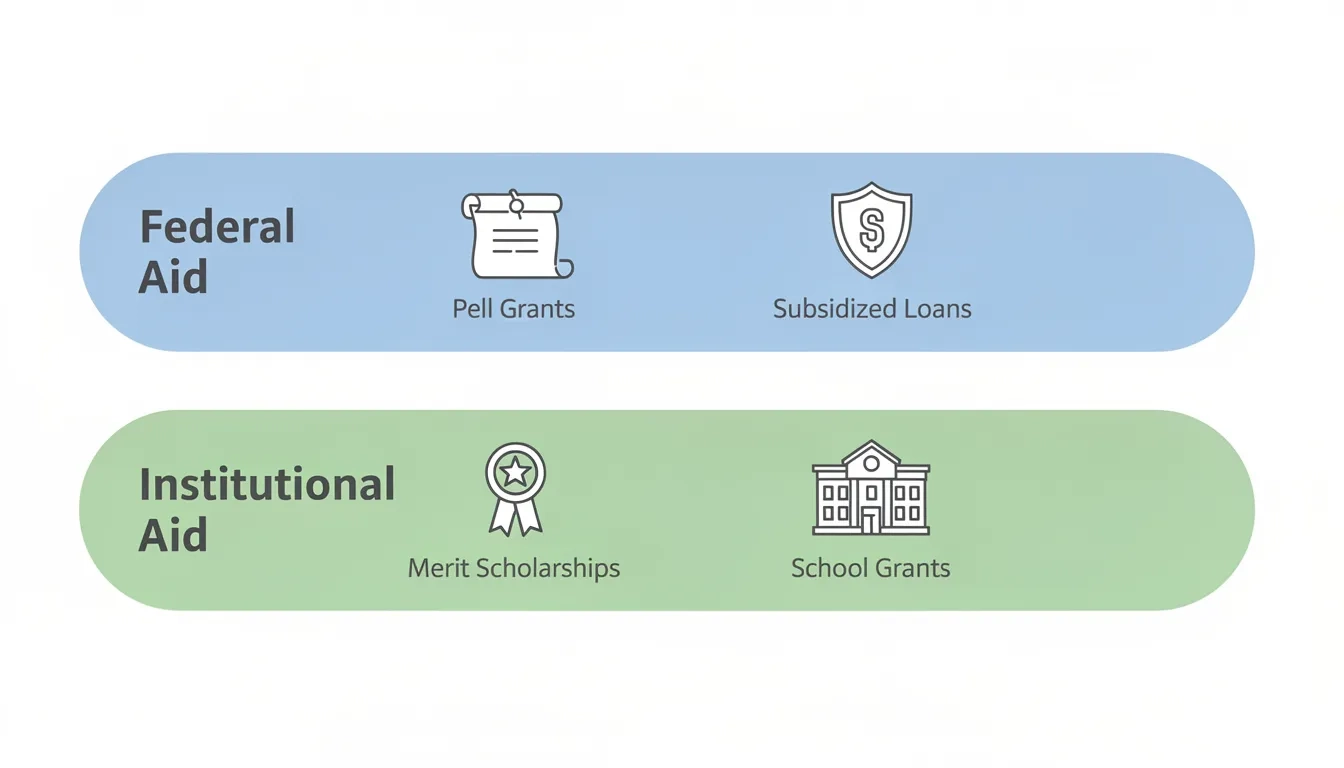
There are at least four meaningfully different types of financial aid estimators, and they answer completely different questions. Running the Federal Student Aid Estimator when you need a CSS Profile school's estimate is like checking a flight map to figure out traffic. Related concept, useless output.
The Two-Track System Nobody Explains First
Before comparing any tools, you need to understand the system underneath them. Because without this, every calculator number is going to confuse you.
Federal Methodology is what the FAFSA uses. It calculates your Student Aid Index (SAI) — which replaced the old Expected Family Contribution starting with the 2024–25 cycle — and determines your eligibility for federal grants, loans, and work-study. The formula is public and relatively transparent.
Institutional Methodology is a separate, proprietary formula used by roughly 300 colleges that also require the CSS Profile. These schools — mostly private and selective — use this second calculation to award their own grant dollars. It asks deeper questions: home equity, non-custodial parent income, small business assets, even medical expenses. The formula itself is not published.
The core math is the same for both tracks: Cost of Attendance minus your SAI (or institutional equivalent) equals your demonstrated financial need. But what counts as "your contribution" varies significantly between the two formulas. A family that looks Pell Grant-eligible under Federal Methodology might see a much higher expected contribution from a CSS Profile school that counts their home equity.
This is why picking the right estimator matters before you build your college list, not after.
The Federal Student Aid Estimator: Solid Start, Limited Reach
The Federal Student Aid Estimator at studentaid.gov is the government's own preview tool. Free, takes about 20 minutes, and uses prior-prior year tax data — for the 2025–26 year, that's your 2023 tax return.
What it does well: it estimates your SAI, tells you whether you'd likely qualify for a Pell Grant (which maxes out at $7,395 for 2025–26), and gives you a rough sense of federal loan eligibility. For families who've never engaged with financial aid before, it's genuinely clarifying.
The limits are real, though. According to the Department of Education's own documentation, the tool uses national average figures for work-study amounts, doesn't account for state grants, and has no visibility into school-specific scholarships or institutional aid. So you might see a reasonable-looking number and still be blindsided by what an individual school actually offers.
The Federal Student Aid Estimator is a preview of your federal aid picture — not a prediction of what any specific college will charge you.
Think of it as a litmus test. It tells you which bracket you're in, not what your bill will be.
When to use it: Spring of junior year in high school, before you've built your application list. Run it once, understand your SAI, then move to school-specific tools.
Net Price Calculators: Required by Law, Wildly Variable in Quality
Every college receiving federal financial aid funds is legally required to publish a net price calculator on its website. That law has been on the books since 2011. But "having one" and "having a useful one" are two very different things.
Net price calculators draw from each school's actual historical financial aid data. They show what students with similar financial profiles actually paid at that institution, after grants and scholarships, in the prior year. That's the closest you can get to a real prediction without submitting an actual application.
The accuracy gap between different schools' calculators is enormous. Harvard's calculator asks highly specific questions about assets, home equity, divorce status, and sibling enrollment, and financial aid officers consistently describe its estimates as reliable. Some smaller schools offer calculators that ask five questions and produce an estimate range so wide — sometimes $20,000 to $60,000 — that it's nearly useless for planning.
Here's the non-obvious insight: the length and depth of a school's net price calculator is itself a signal about how seriously that institution takes financial aid. A calculator that takes 20 minutes probably has a methodology worth trusting. One that resolves in 3 questions probably doesn't.
The Department of Education's Net Price Calculator Center at collegecost.ed.gov lets you access tools for thousands of schools from one starting point, which beats hunting through each school's website individually.
The College Board SAI Calculator: For Any CSS Profile School
If your target list includes any selective private universities, the College Board's calculator at npc.collegeboard.org is worth your time. It handles both Federal Methodology and Institutional Methodology, which makes it uniquely useful for the schools that use the CSS Profile.
The CSS Profile itself costs $25 for the first school and $16 for each additional one (fee waivers are available for eligible families). The calculator, however, is free, and using it before you finalize your list can prevent the specific pain of falling in love with a school and then discovering you can't make the numbers work.
The CSS Profile captures financial detail that the FAFSA largely ignores:
- Home equity on your primary residence
- Non-custodial parent income in divorce situations
- Small businesses with more than 100 employees
- Non-qualified annuities and certain retirement assets
- Medical expenses and documented unusual circumstances
The practical consequence: a family with $180,000 in home equity and a modest income might look Pell-eligible under Federal Methodology but be expected to contribute $9,000–$14,000 more per year by a CSS Profile school that folds that equity into its calculation. Running the College Board's tool first tells you this before you invest in applications.
Third-Party Tools: FinAid, Saving for College, and the Rest
Beyond government and College Board tools, a few third-party calculators have earned genuine reputations for being useful.
FinAid's SAI Calculator at finaid.org is the most technically detailed free tool available. It walks through the federal SAI formula nearly line by line, asking for adjusted gross income, specific asset breakdowns, and household size. For 2025–26, it correctly applies the prior-prior year rule using 2023 tax data. One specific note from the site: if a student's 2023 income was $11,400 or less, no student income contribution is expected — a nuance that matters a lot for students who worked during high school.
Saving for College's calculator runs a simplified SAI calculation and lets you toggle different scenarios to see how changes in income or asset positioning affect your number. Useful for "what if we paid off the car loan before filing" modeling.
Niche True Cost takes a different angle entirely. It shows full four-year cost breakdowns for specific schools, combining federal data with user-submitted financial aid offers. Better for comparison shopping across a school list than for precise aid prediction.
The CFPB's "Your Financial Path to Graduation" tool is designed specifically for comparing actual award letters once schools accept you — not for early estimation, but for making the final enrollment decision intelligently.
The Tool Comparison at a Glance
| Tool | What It Estimates | Best For |
|---|---|---|
| Federal Student Aid Estimator (studentaid.gov) | Federal aid only — Pell, loans | Early SAI check, Pell eligibility |
| School Net Price Calculator | School-specific grants and aid | Evaluating individual target schools |
| College Board Calculator (npc.collegeboard.org) | Federal + CSS Profile institutional aid | Any CSS Profile school applicants |
| FinAid SAI Calculator (finaid.org) | Detailed federal SAI formula | Understanding the SAI line by line |
| Niche True Cost | Total four-year cost by school | Cross-school cost comparison |
| CFPB Financial Path Tool | Comparing actual award letters | Post-acceptance decision-making |
| Saving for College Calculator | Simplified SAI with scenario modeling | Testing asset positioning scenarios |
What These Tools Cannot Predict
Here's the part most guides skip entirely.
Merit aid. Schools award merit scholarships based on GPA, test scores, extracurriculars, and institutional enrollment goals — none of which appear in any financial aid formula. A student with strong stats applying to a school that's actively recruiting her profile might receive $17,500 in merit aid that no calculator would predict. That's real money, and it only comes from applying.
Negotiation outcomes. Many schools will revise aid packages when given competing offers. A documented counteroffer from a peer institution can shift a package by several thousand dollars. No estimator models this.
Professional judgment appeals. If your family has unusual circumstances — a parent's recent job loss, significant medical expenses, a business downturn — a financial aid officer can adjust your SAI through a process called professional judgment. Estimators work from formulaic inputs; human appeals work from documentation.
Also: schools are not required to meet 100% of demonstrated need. Only about 100 institutions in the country formally commit to this. The difference between a school that meets 85% of need and one that meets 100% can be $8,000–$15,000 per year — and no calculator will flag that gap for you. You have to look up each school's policy directly.
Common Mistakes That Skew the Numbers
A few errors show up constantly when families use these tools.
Using the wrong tax year. For 2025–26 applications, you use 2023 taxes. Using 2024 numbers — even if they feel more accurate — will produce wrong outputs because the formula depends on the prior-prior year rule specifically.
Ignoring asset ownership. Money held in a student's name counts against aid eligibility at roughly 20 cents on the dollar. Money in a parent account counts at up to 5.64 cents on the dollar. Moving funds from a student UTMA into a parent account (when legally appropriate) before filing can shift a family's SAI by a meaningful amount. Most calculators let you model this. Most families never try.
Treating any single calculator as the final word. No individual tool covers every aid source — federal, state, institutional, and merit. The right workflow is to stack them: start federal, then go school-specific, then account for merit potential separately.
Bottom Line
- Run the Federal Student Aid Estimator at studentaid.gov first, in the spring of 11th grade. It sets your SAI baseline and tells you whether you're in Pell Grant territory.
- For each school on your target list, run that school's net price calculator individually. A school with a detailed 20-minute calculator is giving you more useful data than one with a 5-question shortcut.
- If any CSS Profile school is on your list, use the College Board's calculator before applying — especially if your family has significant home equity or involves divorced parents.
- Use FinAid or Saving for College to model asset positioning scenarios before your filing date.
- After acceptances arrive, use the CFPB comparison tool to read award letters side by side.
My honest take: the Federal Student Aid Estimator plus each school's net price calculator handles 80% of what most families need. The College Board's tool is worth the extra 20 minutes if a single selective private school is on your list. Don't skip the school-specific calculators — that's where the real number lives.
Frequently Asked Questions
How accurate is the Federal Student Aid Estimator really?
It's reliable for predicting federal Pell Grant eligibility and your SAI bracket. But it uses national averages for work-study and has zero visibility into state grants or school-specific awards. Treat it as a floor estimate. Your actual package will vary depending on which school you attend and whether they commit to meeting full financial need.
Do I need to run a separate net price calculator for every college?
Yes, and it's worth the time. A school that looks expensive at sticker price might have a net price that's $23,847 lower per year once grants are applied — you won't know until you run their specific calculator. Schools with similar published tuitions can have drastically different net prices for the same family income.
Is the CSS Profile's formula harder on families than the FAFSA?
Often, yes — for families with home equity or non-custodial parent income. The CSS Profile's Institutional Methodology counts assets that the FAFSA formula largely ignores, which tends to raise the expected contribution. But CSS Profile schools also tend to have bigger institutional grant budgets, so the net result isn't automatically worse. Run both formulas and compare before drawing conclusions.
Can I use these calculators to legally reduce my expected contribution?
The calculators reflect the real formulas. Understanding asset ownership rules — such as the fact that student-held assets count more heavily against aid than parent-held assets — is legal financial planning, not manipulation. Misrepresenting assets on the actual FAFSA is a federal offense. The planning should happen before the filing, not on the form itself.
When is the right time to start using financial aid estimators?
Spring of 11th grade. By then you have your 10th grade (prior-prior) year tax data available, and you have enough time to let the estimates shape your college list before paying application fees. Students who wait until senior year use these tools reactively rather than strategically.
What's the difference between net price and cost of attendance?
Cost of Attendance is the sticker price — tuition, fees, room, board, books, and estimated personal expenses. Net price is COA minus grants and scholarships only. It does not subtract loans or work-study, because you still have to repay loans. Net price is the number you should be comparing across schools; cost of attendance comparisons are almost always misleading.
Sources
- Federal Student Aid Estimator
- How the Federal Student Aid Estimator Differs from the FAFSA
- Net Price Calculator Center – U.S. Dept. of Education
- Best Financial Aid and Student Loan Calculators for 2026 – Fastweb
- FinAid SAI Calculator
- College Board Net Price Calculator
- Student Aid Index SAI Chart 2026–27 – The College Investor
- 6 Top College Price Tools for Students and Parents – Money