Eagle Scout Scholarships 2026: How to Find and Win Every Award
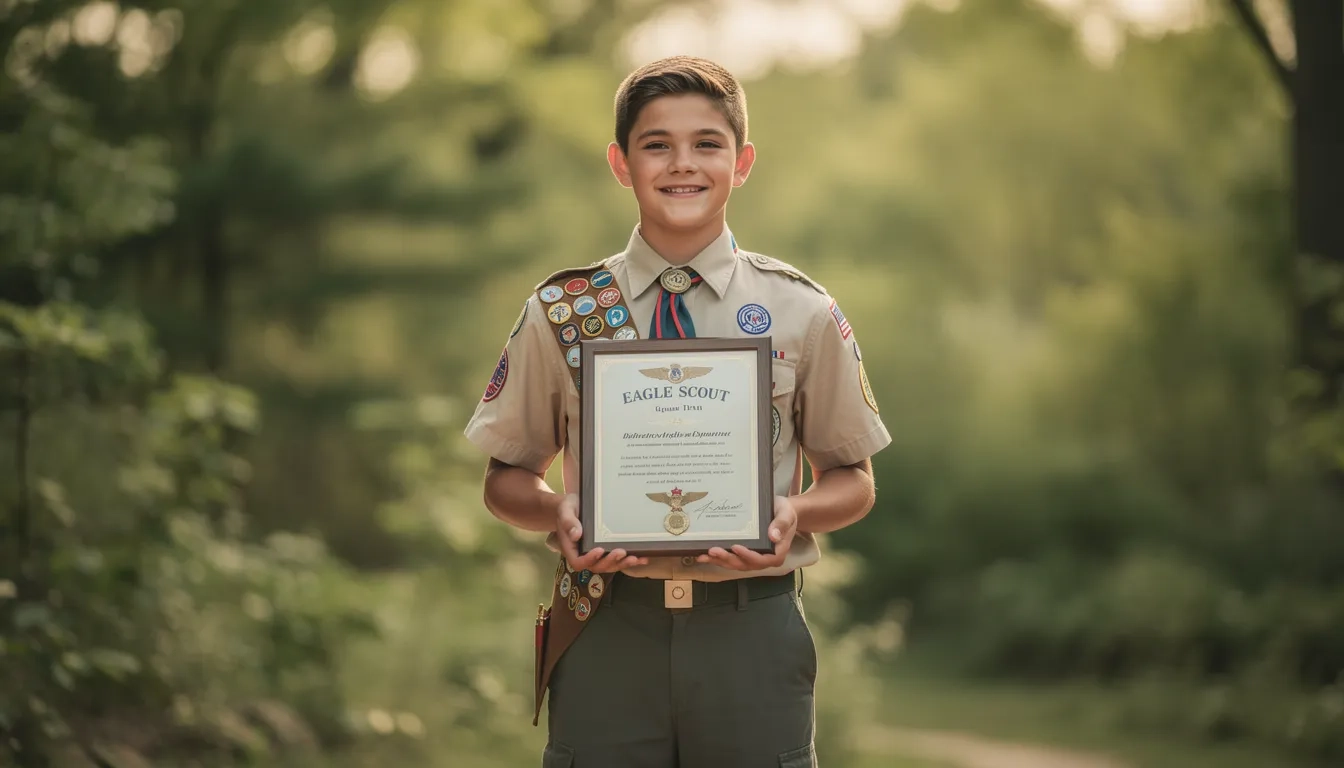
In 2024, the National Eagle Scout Association received more than 4,300 scholarship applications and awarded exactly 69 of them. That's a 1.6% acceptance rate — tighter than most Ivy League schools. If you've been assuming Eagle Scout status means money flows your way automatically, this is the reality check you need before December 1.
The good news? Those 4,300 applicants were all competing for one pool of money. Dozens of other scholarships — from civic organizations, religious committees, university automatic awards, and local councils — sit completely separate from that competition. Many go undersubscribed every year because scouts simply don't know they exist. The total available funding across all these programs runs well past $500,000 annually. The scouts who benefit most aren't necessarily the ones with the best credentials. They're the ones who find every bucket.
Here's where all the buckets are.
NESA Scholarships: The Flagship Competition
The National Eagle Scout Association administers the most recognized portfolio of Eagle Scout scholarships, and the top prizes are genuinely significant.
The Lawrence S. and Mabel Cooke Scholarship awards one four-year, $50,000 grant (paid at up to $12,500/year) plus four regional four-year awards of $30,000 each. A separate STEM-focused Cooke adds another $50,000 for scouts planning to major in science, technology, engineering, or math. Below those flagship grants, the Merit tier spreads opportunity more widely:
- Hall/McElwain Merit Scholarships: 40 awards of $5,000 each
- Hansen & Mary Hall Scholarships: one per Council Service Territory (14 total) at $7,000 each
- NESA Scholarship Endowments: one per CST at $6,000 each (14 total)
- Robert and Rebecca Palmer Scholarships: three awards of $2,500
- Bailey Scholarships: one $4,000 and one $2,000 award
- Malone/Windrush Scholarship (journalism-focused): one $2,500 award
Application window: December 1, 2025 through January 31, 2026 at 11:59 p.m. CST. Hard deadline, no exceptions.
Two rules catch scouts off guard every cycle. First, NESA requires active paid membership (a separate registration from BSA itself) to submit any application. If your membership lapsed after earning Eagle, renew before the window opens. Second, NESA awards each scout only once in their lifetime. Apply when you're most competitive, not just when you first become eligible.
Eligibility spans high school senior year through junior year of undergraduate study. Full-time enrollment in an accredited academic or skilled trade program qualifies. Graduate degrees and military academies do not.
Civic and Religious Organization Scholarships
The American Legion Eagle Scout of the Year is worth stopping on. The winner receives a $10,000 scholarship; three runners-up each get $2,500. To be eligible, scouts need their Eagle rank, a religious emblem, and a connection to an American Legion post. The nomination window opens November 1 and runs through March 1 at the state level, with final packets due at national headquarters by April 1.
Each state's American Legion Department selects one candidate internally before forwarding to nationals — so the real competition happens at the state level, a much smaller pool than any national contest.
The Veterans of Foreign Wars runs a parallel three-tier program at $5,000, $3,000, and $1,000.
Religious communities add a layer of awards that most scouts completely overlook:
| Organization | Award Details | Amount | Deadline |
|---|---|---|---|
| National Catholic Committee on Scouting | 7 scholarships, $38,000 total pool | $2,000–$5,000 each | March 1 |
| Jewish Committee (Chester M. Vernon Memorial) | 1 award | $4,000 (4-year disbursement) | January 31 |
| Jewish Committee (Frank L. Weil Memorial) | 1 award + 2 runner-ups | $1,000 + $500 each | January 31 |
| Eastern Orthodox Scouting Committee | Up to 2 awards | $1,000 each | May 1 |
The NCCS scholarships specifically require the Ad Altare Dei or Pope Pius XII religious emblem. If you earned one during your Scouting years, track down that paperwork — it could be worth $5,000 you haven't claimed yet.
University Automatic Awards: No Competition Required
Some colleges have standing policies that grant Eagle Scouts automatic financial awards upon enrollment. These aren't competitive. They trigger when you enroll, which means finding them before you apply can meaningfully change your cost comparison across schools.
Known universities with Eagle Scout awards as of 2026:
- Hampden-Sydney College (Virginia): automatic scholarship for any admitted Eagle Scout
- University of Mississippi: institutional Eagle Scout scholarship
- Florida Institute of Technology: dedicated Eagle Scout award
- Lipscomb University (Tennessee): Eagle Scout scholarship
- University of Southern Mississippi: institutional recognition award
- Abilene Christian University (Texas): $1,000 automatic award
The Lawrence Strader Boy Scouts of America Scholarship is a standout for Tennessee scouts specifically: $9,000 per year for up to four years, requiring at least three years of BSA involvement and a minimum 2.5 GPA. That's $36,000 total available to qualifying applicants — a number that belongs in any college cost analysis.
Only about 4% of all Boy Scouts reach Eagle rank. That selectivity matters on an admissions file. It tells a school something a transcript can't — that you built something real, led real people, and finished what you started.
One caveat worth repeating: university scholarship policies change without much notice. Before factoring any of these into your financial planning, call the school's financial aid office and ask for written confirmation.
Local Council Scholarships: The High-Percentage Play
Here's the pattern most Eagle Scout scholarship guides miss entirely: local council awards have dramatically better odds than national competitions. They draw from a small geographic pool, have simpler application requirements, and many go undersubscribed every single year.
Some 2026 examples from different regions:
- Northeast Georgia Council (NEGA-BSA): Five $1,000 scholarships for Eagle Scouts graduating spring 2026. Five awards for a region, not a nation.
- Greater Los Angeles Scouting (Belcher Foundation): A $7,000 two-year scholarship ($3,500/year) renewable for a second year.
- Greater Hudson Valley Scouting: Coordinates regional NESA nominations and administers its own separate awards.
Most of these opportunities aren't listed in any national database. They're on the council's own website, sometimes buried in an announcements section. The move is to contact your local Scout Executive directly in September or October and ask specifically what scholarship support exists for Eagle Scouts in your area. Do this in the fall — not the spring, when most deadlines have already passed.
Application Strategy: What Actually Moves the Needle
Most Eagle Scout scholarship guides tell you to "apply early and highlight your leadership." Correct, but nearly useless without specifics.
Your Eagle project essay is probably not your strongest option for NESA applications. According to IvyScholars, writing about the Eagle project "may not be the best topic" precisely because every single applicant completed one. Judges read thousands of trail-building and food-drive summaries. The essay that differentiates you discusses something else: a leadership failure you recovered from, a problem you identified independently of any badge requirement, a moment where your thinking genuinely changed.
Here's the strategy framework that actually works:
- Join NESA the month you earn Eagle. Membership costs roughly $25/year for youth members. Scouts who wait and scramble before the January 31 window sometimes find they're ineligible because they never registered. Don't let a $25 oversight block access to tens of thousands in awards.
- Customize each application. The American Legion award weights veteran community connections. NCCS weights religious involvement alongside Scouting achievement. Hall/McElwain weights broad merit. A single generic application performs poorly across all of them.
- Stack smaller awards without hesitation. A $2,500 Palmer Scholarship plus a $1,000 local council award plus a $1,000 university automatic grant is $4,500 before you've entered any major competition. ScoutSmarts puts it plainly: "don't turn your nose up at scholarships in the hundreds or low thousands of dollars." Over four years, that arithmetic matters.
- Know the GPA floors. NESA Academic Scholarships typically require a minimum SAT of 1,290 or ACT of 28. The Lawrence Strader requires a 2.5 GPA. If you're near a threshold, prioritize merit-based programs that weight service and leadership more heavily than test scores.
One more thing: build a spreadsheet in October. List every award you're eligible for, its deadline, its requirements, and whether it's one-time or renewable. Scouts who do this consistently apply to 8–12 scholarships; scouts who don't apply to 2 or 3. The gap in outcomes is not mainly about talent.
Bottom Line
- Hit the NESA January 31 deadline. It's the largest prize pool and the most competitive. Active NESA membership is non-negotiable — create it the month you earn your Eagle, not the week before applications close.
- Check religious and civic affiliations. If you earned a religious emblem, the NCCS, Jewish Committee, or Eastern Orthodox Scouting scholarships may have money you haven't touched. The American Legion's $10,000 award is worth pursuing for any scout with a post connection.
- Call your local council in October. Local scholarships carry the best odds in the whole ecosystem. They often appear nowhere except the council's own website, and many go unclaimed each year.
- Write a different essay. Everyone has an Eagle project. Only you have your story.
My honest take: most Eagle Scouts leave scholarship money on the table not because they're unqualified, but because these awards are scattered across a dozen different organizations. The scouts who do best financially aren't necessarily the most impressive candidates. They're the ones who spent a few hours in October building a list of every award they qualify for and then hit every deadline. That discipline — showing up and following through — is exactly what Eagle Scout training is supposed to build. Use it.
Frequently Asked Questions
Do you have to be a high school senior to apply for NESA scholarships?
No. NESA scholarships are open from senior year of high school through junior year of undergraduate study. College freshmen and sophomores who haven't yet applied can still compete — and may be stronger candidates because they can show actual college-level academic performance. Don't assume the window closed just because you waited a year.
Is there any Eagle Scout scholarship that's automatically guaranteed?
A handful of universities — including Hampden-Sydney College, Abilene Christian University, and Florida Institute of Technology — grant automatic institutional awards to enrolled Eagle Scouts. No application required beyond enrollment. At the national level, though, no award is automatic. NESA, American Legion, and religious organization scholarships all require separate applications and competitive selection.
Can an Eagle Scout apply to both NESA and the American Legion scholarship in the same year?
Yes, and you should. They are entirely separate programs from separate organizations. NESA closes January 31; the American Legion state deadline is March 1. Applying to both is standard practice and strategically smart since the award criteria differ.
What's the most common mistake Eagle Scouts make on scholarship applications?
Writing about their Eagle project in every essay. It's the most common topic and the least differentiating one — every other applicant completed a project too. The second most common mistake is not joining NESA immediately after earning Eagle, which makes every NESA scholarship permanently inaccessible until you correct it.
What is the NESA World Explorer Scholarship?
It's not a traditional cash award. The World Explorer program connects Eagle Scouts with international research and service partnerships where out-of-pocket cost runs around $600 for experiences that would otherwise cost thousands. Application runs August 1 through October 31. It won't cover tuition, but if global service or field research is your goal, it's worth a look.
Does Eagle Scout status help with military service academy admissions?
Yes, in specific and documented ways. Congressional nominations for service academies like West Point and the Naval Academy explicitly recognize Eagle Scout rank as a credential during the nomination review. Beyond admissions, Eagle Scouts who enlist in the regular military typically begin at the E-3 pay grade rather than E-1 — a meaningful financial difference that compounds over an enlistment period.
Sources
- Scholarships — National Eagle Scout Association (NESA)
- Eagle Scout Scholarships Made Simple — ScoutSmarts
- Top Eagle Scout Scholarships for 2026 — Scholarships360
- American Legion Eagle Scout of the Year Scholarship
- National Eagle Scout Association Scholarships — Ivy Scholars
- 2026 Belcher Foundation Eagle Scout Scholarship — Greater LA Scouting
- 2026 Clarice Bagwell Eagle Scout Scholarship — NEGA-BSA