Cover Letter Writing Guide for Students (With Examples)
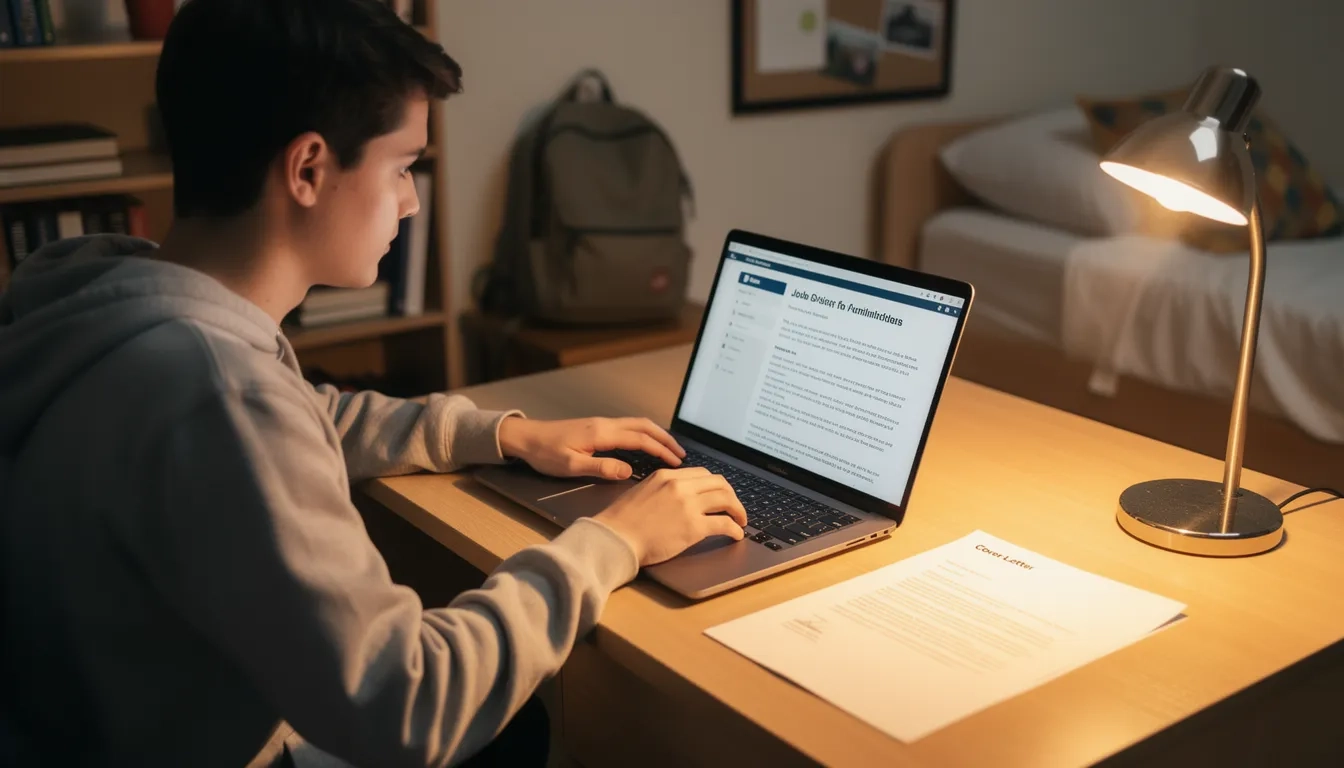
The data on cover letters is more lopsided than most students realize. According to Jobscan research, candidates who consistently include a cover letter get hired at a rate of 35.8%, compared to 21.2% for those who never submit one. That's not a rounding error. For a student with a thin résumé and real competition, it might be the biggest available edge in the whole application process.
Most students treat cover letters like a formality. Copy the resume, add a polite sentence, hit send. This guide is about doing something different.
Why Cover Letters Still Matter (Even When They're "Optional")
You've seen the job posting. Buried at the bottom: "cover letter optional." A lot of applicants read that as permission to skip it.
Submitting when it's "optional" is actually your best opportunity. A 2025 survey found that 83% of hiring managers still read cover letters even when they aren't required, and 72% expect one regardless of what the listing says. When half your competition opts out, showing up becomes a differentiator.
This matters especially for students, whose résumés tend to look alike. Similar GPAs, similar clubs, similar one-line job descriptions. A cover letter is the one space where you can sound like a person rather than a template.
There's also a timing angle worth knowing: 41% of hiring managers say the introduction is the single most important part of a cover letter. Getting those first three sentences right carries more weight than anything else on the page.
The Mistake That Kills Most Student Cover Letters
Most students, when they sit down to write a cover letter, spend the first paragraph apologizing.
"Although I don't have direct work experience in this field..." "While I may not meet all the qualifications..." "As a student, I haven't yet had the opportunity to..."
Career coach Eloïse Eonnet, who advises early-career candidates at The Muse, puts it plainly:
"Rather than focusing on what you have not accomplished yet in your career, focus on what you bring to the table: your skills, competencies, personality traits, and the values that you have developed in your life and education."
Hiring managers for entry-level roles already know you don't have ten years of experience. They're evaluating something else entirely: whether you understand the role, whether you can communicate clearly, and whether you seem coachable. An apology signals none of that.
A 300-400 word cover letter is a tight document. Every sentence needs to be working for you.
What Actually Counts as Experience
Here's where students consistently undersell themselves. Transferable experience is real experience. It just doesn't look like a LinkedIn job history.
If you've led a student organization, you've done stakeholder management under resource constraints. If you've written a 40-page thesis, you've done independent research and project delivery against a hard deadline. If you helped run a campus fundraiser for 200 attendees, you've managed logistics with a team and almost certainly on a shoestring budget.
None of this needs quotation marks. Don't call it "just school work." Frame it as what it actually is.
What counts:
- Academic projects with a defined scope and deliverable (research papers, capstone projects, case competitions)
- Campus leadership in clubs, honor societies, student government, or residence life
- Volunteer work, especially if sustained over several months
- Informal or freelance work: tutoring, social media management, graphic design for a local nonprofit
- Internships, even short or unpaid ones
- Class-based competitions: hackathons, mock trials, pitch competitions
The key is specificity. "I served as treasurer of my university's finance club" lands better than "I have financial management experience." Better still: "As treasurer of the 47-member Finance Society at Ohio State, I managed a $12,000 annual budget and reduced operating costs by 18% over two semesters."
Numbers make claims credible. Even small ones.
How to Structure Your Cover Letter
The best format for entry-level applicants is a skills-focused three-paragraph structure. Each paragraph has one job.
| Section | Word Count | Purpose |
|---|---|---|
| Opening | 50–75 words | Hook + why this role at this company |
| Body | 150–200 words | Specific skills or examples tied to the job description |
| Closing | 50–75 words | Call to action and genuine interest |
The opening paragraph should skip "I am writing to apply for..." entirely. That sentence has appeared in millions of cover letters and signals nothing. Start with something concrete — why this company, at this moment, based on real research. If you attended a company info session and heard something that clicked, say that. Specific beats polished every time.
The body paragraph is where you make your argument. Pick two or three examples that tie your experience directly to the skills listed in the job description. Read the posting carefully. The exact language they use tells you what they're evaluating. Address those things specifically, not a generic list of competencies.
The closing should be short and direct. "I'd welcome the chance to talk more about how my background in X could contribute to Y" beats "Please give me a chance." One sentence requesting a next step is enough.
Writing an Opening Line That Doesn't Get Skipped
The elephant in the room with cover letters is that many hiring managers skim rather than read. Which means your opening line does more work than everything else combined.
Jobscan data found that candidates who always include a cover letter are 1.9 times more likely to land an interview than those who don't. But that number only helps if someone actually reads yours.
Three opening approaches that consistently work for students:
- Lead with a specific connection: "I've been following [Company]'s work in urban food access since your partnership with Second Harvest Heartland ran in last October's issue of Fast Company."
- Lead with a relevant result: "Last semester, I built a survey tool for my sociology department that cut data entry time from six hours per week to 37 minutes."
- Lead with a direct answer to their need: "You're looking for someone who can write clearly and think analytically. I've spent the past two years doing both."
What doesn't work: opening with your name and degree. That's already on your résumé. Vague enthusiasm ("I am passionate about marketing") tells a recruiter nothing they haven't already read today.
Personalizing Without Starting From Scratch Every Time
Personalization is non-negotiable. In a 2025 hiring manager survey, 81% said they preferred letters tailored to the specific position, and 78% said they could easily spot a generic one. A letter that could have been sent to any employer will get treated like one. That's just how it goes.
But writing a completely original letter for every application isn't realistic if you're applying to 15 or 20 places. Here's what actually works: a modular base letter.
Write one strong version with your core pitch and your best two or three examples. Then, for each application, swap in:
- A new opening paragraph specific to that company (requires 10 minutes of actual research)
- Adjusted skill emphasis based on what the job description prioritizes
- A customized closing that references the specific role by name
This takes about 15 to 20 minutes per application. Not trivial, but not starting from zero either.
A note on AI tools: 80% of hiring managers say they can detect AI-generated content, and 57% say it makes them less likely to hire the candidate, according to The Interview Guys citing HireVue survey data. Using AI to generate your entire letter is a high-risk move. Use it to catch typos, refine awkward phrasing, or brainstorm — but the specific examples, company research, and voice need to come from you. Nobody else has your exact experience as treasurer of a 47-member finance club.
Common Mistakes That Cost You the Interview
Beyond the apology problem, a few patterns show up consistently in rejected student letters.
- Typos or misspelling the company name. About 58% of employers immediately reject letters with obvious errors. One proofreading pass prevents this entirely.
- Copying job description language verbatim. It reads like keyword stuffing and signals you didn't actually process what the role requires.
- Making it about what you want. "This role would be great for my development" tells the employer nothing about why you're great for them.
- Going over one page. 70% of hiring managers prefer letters of half a page or less. If you're at 500 words, cut.
- A weak or unsearchable filename. "CoverLetter_Final.docx" looks disorganized. "JaneDoe_Google_CoverLetter.pdf" is easy to find in a crowded downloads folder.
The closing line matters more than people realize. Letters that reference a specific next step ("I'm available for a call any time after April 14th") convert better than passive sign-offs like "I look forward to hearing from you."
Bottom Line
- Submit the cover letter. Especially when it's listed as optional — that's when it separates you from the field.
- Lead with what you have, not what you lack. Academic projects, campus leadership, and volunteer work are real, frame-able experience.
- The opening carries the most weight. Make it specific, make it concrete, and skip the generic first sentence.
- Use a modular approach to personalize at scale: one strong base, then swap in the key sections per employer.
- Keep it under 400 words. If you can't make your case in half a page, the case isn't clear enough yet.
Frequently Asked Questions
Do hiring managers actually read cover letters, or is it mostly a formality?
More than the conventional wisdom suggests. According to a 2025 survey, 83% of hiring managers read cover letters even when submission is optional, and 94% say they influence who gets an interview. The "nobody reads them" belief persists mostly among people who've never worked in recruiting. For entry-level candidates with thin résumés, a strong cover letter can genuinely move the needle.
What should I write if I have zero work experience?
Focus on transferable experience from school: research projects, class competitions, campus organizations, sustained volunteer commitments, or freelance work. Be concrete — name the project, describe your specific contribution, and include a number wherever you honestly can. Hiring managers for entry-level roles expect thin job histories; they're evaluating initiative, communication ability, and fit, not a list of past employers.
How long should a student cover letter be?
Three paragraphs, 300 to 400 words, one page maximum. A 2025 survey found that 70% of hiring managers prefer letters of half a page or less. Going over that length rarely helps and often signals that the candidate hasn't edited their own work — not a great signal when applying to writing-adjacent roles.
Is it a problem to use AI to write my cover letter?
It can be. 80% of hiring managers say they can detect AI-generated content, and 57% say it negatively affects their hiring decision. Using AI to organize your thoughts, refine a sentence, or check for errors is reasonable. But the specific examples, company research, and opening hook need to come from you — that's exactly what AI can't replicate from your own experience.
Should I address the letter to a specific person if I don't know the hiring manager's name?
Yes, and it's usually findable. Five minutes on LinkedIn or the company's website gets you a name most of the time. "Dear Ms. Rodriguez" reads very differently from "Dear Hiring Manager." If you genuinely cannot find a name after looking, "Dear [Team Name] Team" is a neutral fallback that's better than "To Whom It May Concern."
What file format should I use when submitting a cover letter?
PDF, almost always. Word documents can shift formatting depending on the reader's software version. Name your file clearly: FirstName_LastName_CompanyName_CoverLetter.pdf. Some applicant tracking systems specifically request Word or plain text — follow those instructions when given, since ignoring them suggests you didn't read the application carefully.