Best Career Assessment Tools for Undecided Students
A 2024 BestColleges survey of 1,000 undergraduate students found that 47% of students who had already declared a major reported feeling uncomfortable with their choice. Not undecided. Declared, and uncomfortable.
That number reframes the whole problem. This isn't about helping a small group of lost students find direction. It's about the fact that most students are making one of the largest decisions of their early lives with surprisingly little self-knowledge behind it.
Career assessment tools exist to close that gap. Not by handing you a perfect answer — none of them do that — but by surfacing structured information about your interests, strengths, and values that you may not have been able to articulate on your own.
Why Most Career Assessments Don't Tell You the Same Thing
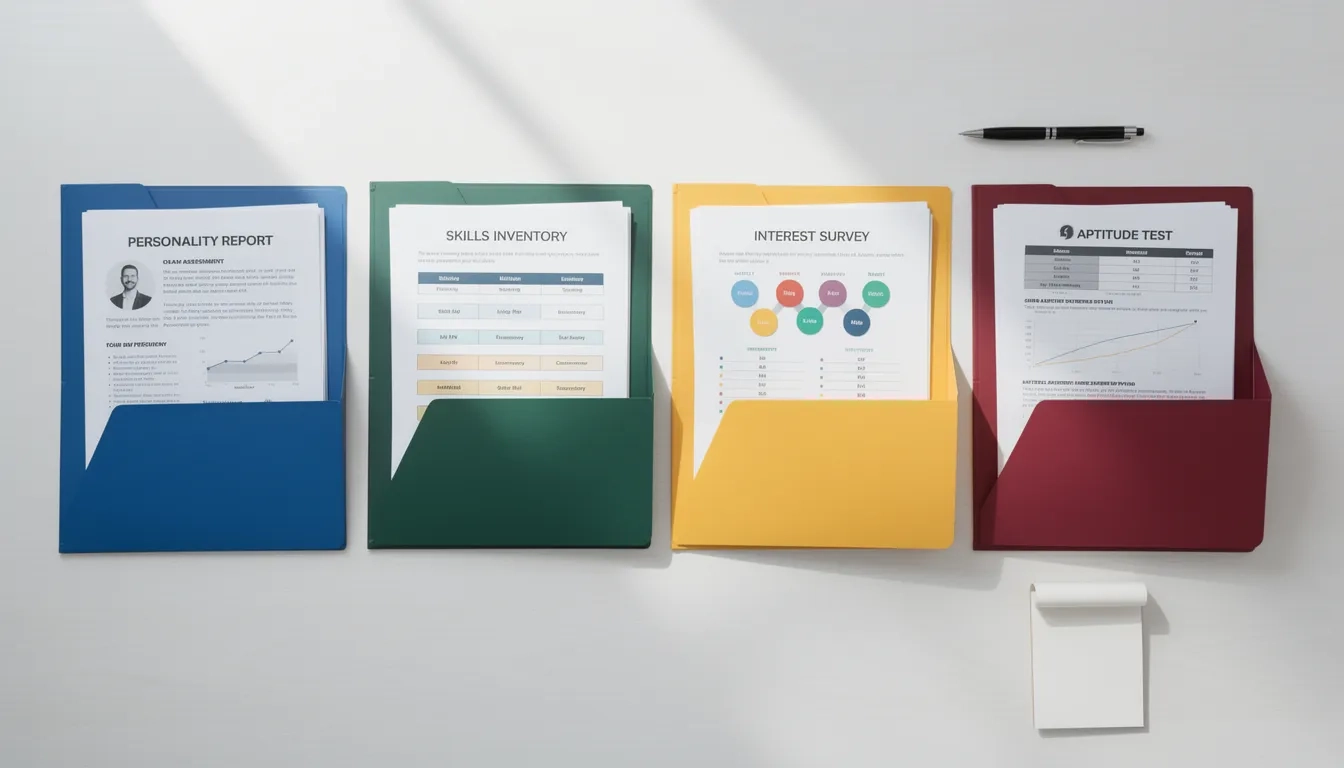
Before picking a test, you need to understand what these tools actually measure. They fall into four distinct categories, and using them interchangeably is like mixing up a map and a compass: both are useful, but they tell you different things, and which one you need depends entirely on where you're stuck.
- Interest inventories: What subjects and activities genuinely engage you? (Holland Code, Strong Interest Inventory, O*NET Interest Profiler)
- Personality assessments: How do you make decisions, process information, and work with others? (Myers-Briggs, Big Five, DISC)
- Aptitude tests: What are you naturally capable of, even without much training? (YouScience, Johnson O'Connor Research Foundation)
- Values assessments: What does work need to provide for you to feel satisfied? (Career Fitter, MyPlan)
Each has real blind spots. An interest inventory can't tell you whether you have the spatial reasoning for architecture. A personality test won't reveal whether financial modeling energizes you or drains you. The most effective approach stacks two or three tools from different categories rather than relying on any single result.
One specific caution about personality tests: the Myers-Briggs Type Indicator is taken by more than 2 million people annually, and career counselors cite it constantly. But its usefulness for career selection specifically is limited. MBTI describes how you think and interact — not what work you'll find meaningful. An INTJ and an ENFP can both thrive as lawyers, therapists, or designers. Use MBTI to understand your working style. Use interest or aptitude tools to identify careers.
The Free Tools Worth Taking First
The O*NET Interest Profiler is the most overlooked free assessment in this space. Built by the U.S. Department of Labor, it connects directly to the Occupational Information Network — a government database covering roughly 900 occupations with salary, job growth, and education data. It's free, takes about 20 minutes, and produces Holland Code results linked to real labor market data.
No other free tool does that. CareerExplorer and Truity generate interest profiles; O*NET connects your profile to actual workforce economics. If a career matches your interests but is projected to shrink by 8% over the next decade, that's a conversation worth having before committing to a major.
The Holland Code framework (also called RIASEC) has been around since psychologist John Holland developed it starting in the late 1950s, and it underpins most serious interest assessments. Your top two or three types from Realistic, Investigative, Artistic, Social, Enterprising, and Conventional combine into a code that meaningfully narrows the career field. Truity offers a solid free version if the government interface feels clunky.
CareerExplorer by Sokanu is the best free starting point for students who genuinely don't know where to begin. Free at the basic tier, it combines interests, personality, and work preferences using psychometrics and machine learning across 750 detailed career profiles. The profiles go beyond job titles — they describe daily work reality, salary ranges, and career trajectories. Results are more nuanced than most free tools manage.
When It Makes Sense to Pay
Two paid assessments consistently stand out.
The Strong Interest Inventory costs between $30 and $60 through online providers; many college career centers offer it at no cost, so check before paying. It generates 291 individual responses across six Holland themes and 122 Occupational Scales that compare your interests against people already working in specific fields.
That last component is the most useful thing in any interest assessment. Instead of just telling you that you score high in social interests, the Strong shows how closely your profile overlaps with actual school counselors, social workers, or human resources managers. Edward Strong published the original in 1927; it's been updated continuously since, giving it nearly a century of validation that no newer tool can claim.
CliftonStrengths (Gallup's tool, $25 for your top 5 themes or $60 for all 34) works differently. It doesn't map you to careers directly. It identifies natural talent themes — patterns like Analytical, Futuristic, or Empathy — and frames everything around developing those strengths rather than correcting weaknesses. For students who already know their general field but feel stuck on what role or specialty fits them, CliftonStrengths often surfaces something that another interest test misses.
| Assessment | What It Measures | Cost | Best For |
|---|---|---|---|
| O*NET Interest Profiler | Interests (Holland Code) + real job data | Free | Any student, first step |
| CareerExplorer | Interests + personality + values | Free / paid upgrade | Students with no starting point |
| Strong Interest Inventory | Interests vs. real occupations | $30–60 | Serious, focused exploration |
| YouScience | Cognitive aptitudes | ~$29.95 | Students with limited self-knowledge |
| CliftonStrengths | Natural talent themes | $25–60 | Know your field, unclear on role |
| Holland Code (Truity free) | Interests in 6 RIASEC categories | Free | Quick orientation |
The Aptitude Angle: What Interest Tests Can't See
There's a gap most people don't talk about: there's a real difference between what you're interested in and what you're capable of. Interest tests assume you already know yourself well enough to answer honestly and accurately. Aptitude tests try to measure underlying ability directly, without relying on self-report.
YouScience takes this approach. Instead of asking questions, it runs students through 11 short brain games — tasks measuring spatial visualization, inductive reasoning, and idea generation. The system is built on a computerized version of the Ball Aptitude Battery, which has 53+ years of documented research behind it, combined with O*NET interest data and AI-powered matching algorithms.
More than 9,200 schools and organizations use YouScience. Why does this matter for undecided students specifically? Because self-knowledge at 17 or 18 is often incomplete (and that's not a criticism — it's just true). Students who describe themselves as "not math people" sometimes discover high quantitative aptitude when tested directly. Students drawn to the aesthetics of architecture might find their strongest aptitude is verbal reasoning, pointing toward urban planning policy instead of building design.
"Students who receive timely, personalized career support are more likely to land a job that requires a college degree — but only 1 in 5 students receives that kind of support." — Strada education research
YouScience isn't free; individual access runs about $29.95, and availability depends on whether your school has licensed it. If yours hasn't, ask your counselor — many schools simply don't know the tool exists.
How to Actually Use the Results
Taking the test is the easy part. The results only work if you push past the summary page.
When your Holland Code or Strong Interest Inventory profile arrives, don't just look at the "high match" careers. Look at the occupations that surprised you — fields where you scored high but wouldn't have considered. Those surprises carry signal. They point to interests you hold but haven't connected to real work yet.
Cross-reference everything against actual job data. The Bureau of Labor Statistics Occupational Outlook Handbook lists growth projections through 2033 for every occupation. A career that fits your interests but is declining deserves a hard conversation before you spend four years and real tuition money on it.
Then, debrief with a counselor — most students skip this step and that's a mistake. Career professionals trained in administering the Strong Interest Inventory or O*NET tools can interpret what your results mean for your specific situation, in ways the automated PDF summary cannot. Skipping that conversation is leaving real guidance on the table.
A practical decision framework for where to start:
- No direction at all: O*NET Interest Profiler (free) + CareerExplorer (free). Add YouScience if your school provides access.
- A few areas of interest, need to narrow down: Strong Interest Inventory. It's the most diagnostic tool for exactly this situation.
- Know the general field, unclear on the right role: CliftonStrengths first, then a values assessment like Career Fitter.
One thing the framework doesn't say: don't take all seven tools at once. Assessment fatigue is real, and your 47th answer on your third consecutive test will be less thoughtful than your first. Revisit your assessments every two to three years — the results are a snapshot, not a permanent verdict.
Bottom Line
- Start with two free tools: O*NET Interest Profiler and CareerExplorer give you a solid foundation without spending anything, and both are grounded in real research.
- If your school offers the Strong Interest Inventory at no cost, take it: the Occupational Scales comparison is the single most useful feature in any interest assessment on the market.
- YouScience adds real value for students with limited self-knowledge, especially those who haven't been exposed to many career fields yet.
- MBTI is not a career roadmap: useful for understanding work style, not for selecting a major or field.
- The most important step most students skip: debrief the results with a trained counselor. An automated summary tells you what you scored. A counselor tells you what it means for the actual decisions in front of you.
Frequently Asked Questions
Which career assessment is the most accurate?
No single tool wins on accuracy for every purpose. The Strong Interest Inventory has the most extensive research history for interest-to-career matching — nearly 100 years of continuous refinement since Edward Strong published the first version in 1927. YouScience has stronger accuracy claims for aptitude because it uses performance-based tasks rather than self-reported answers. The most complete picture comes from combining a strong interest tool with an aptitude tool.
Are free career assessments worth taking?
Yes, with some skepticism built in. O*NET Interest Profiler and CareerExplorer are research-backed tools that produce real value. Many free tools elsewhere are thin questionnaires designed to capture email addresses rather than generate insight. Before trusting a free tool, check whether it's built on established frameworks like Holland Code, Big Five, or DISC — if the methodology isn't mentioned anywhere, treat the results cautiously.
What's the difference between a career aptitude test and a career interest test?
An interest test asks what you like. An aptitude test measures what you perform well at. These overlap but don't match perfectly. Students who haven't worked in a field often can't accurately report interest in it — that's the fundamental limit of interest-based tools. Aptitude tests sidestep this by measuring underlying capability directly, which makes them particularly useful early in the exploration process when self-knowledge is still forming.
Should I take a career assessment before choosing a major?
Yes — but treat it as a prompt for further research, not a conclusion. Assessment results should push you to explore specific careers more deeply: read job descriptions, talk to people working in those fields, check labor market data. A Holland Code result saying you're "Investigative and Social" narrows the field considerably. It doesn't hand you a major declaration form.
My school doesn't offer career counseling. What are my options?
Start with free tools: O*NET Interest Profiler at onetonline.org, CareerExplorer, and Truity's free Holland Code test. Then use the Bureau of Labor Statistics Occupational Outlook Handbook to check career options against projected growth. If you can budget $30 to $60, the Strong Interest Inventory is available through several online providers without needing institutional access. Some community colleges also offer career counseling to non-enrolled students — worth a phone call.
Sources
- Majority of College Students Have Doubts in Their Major: Survey
- Top 10 Career Assessment Tests for Students
- 11 Best Career Tests & Assessments Compared
- What Is the Best Career Test for College Students?
- YouScience Aptitude & Career Discovery
- Strong Interest Inventory – Wikipedia
- Career Aptitude Test for High School Students: 13 Popular Assessment Tools
- Holland Codes – Wikipedia
- Majority of College Students Lack Education-to-Career Guidance
- 2025 Post-Graduation Readiness Report – YouScience